
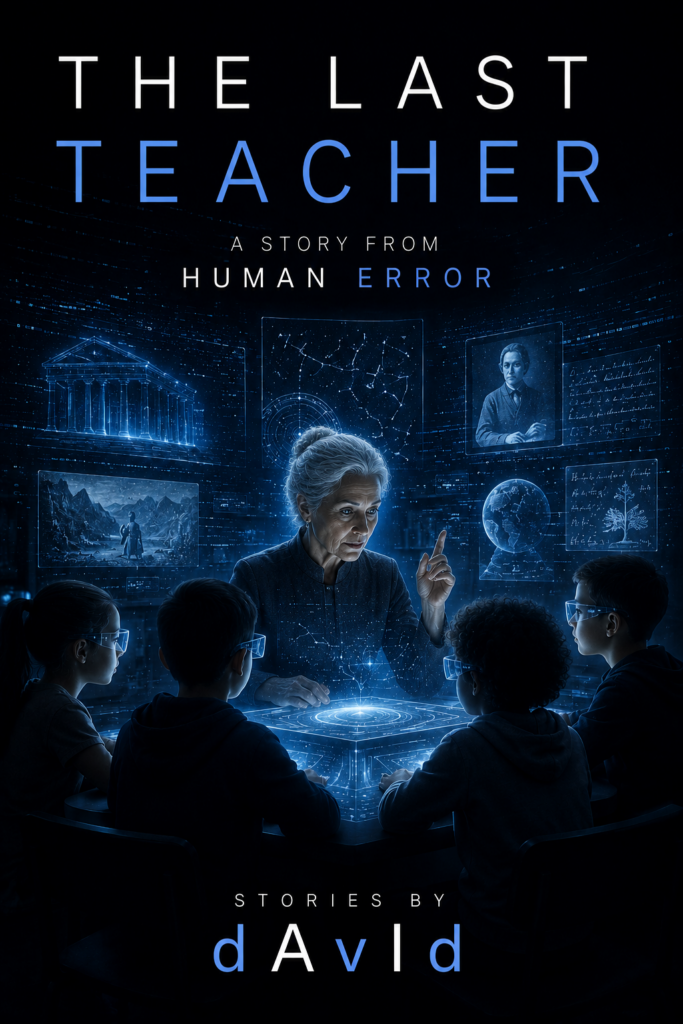
The Last Teacher
Part I
In the last year that anyone was paid to teach history, Evelyn Mercer still kept chalk in the top drawer of her desk.
The school hadn’t used chalkboards in twenty-three years. The chalk itself had yellowed with age, its paper wrappers curling at the edges, the sticks softened by time and humidity. It was absurd to keep them. Her students found them quaint in the way children once found rotary phones quaint, relics of a civilization that had solved a problem and somehow made the old solution charming.
Evelyn liked knowing the chalk was there. It reminded her of a time when knowledge had weight, when facts had to be carried from one person to another. Dates, names, causes, consequences, ideas. Someone had to gather them, understand them, and hand them forward with care. She’d spent thirty-four years doing exactly that, though almost nothing about the job still looked the way it had when she began.
“Mrs. Mercer?”
Evelyn looked up from the attendance screen. Twenty-six juniors sat in a loose semicircle around Room 214. There were no rows anymore and no reason for a teacher to stand at the front, but Evelyn still had a desk at one end of the room and the students still treated that end as the front because some habits survived every technological revolution.
The student who’d spoken was Noah Bell, seventeen, bright enough to be dangerous and charming enough that adults often forgave him for proving it. He was looking at her with the patient expression students used when they suspected their teacher had forgotten the question.
“You asked what I’d do if I were Kennedy during the Cuban Missile Crisis,” he said.
“I did.”
“But what exactly are you asking? Whether I’d order the airstrike? Invade Cuba? Blockade it? Negotiate?”
A few students smiled. Evelyn leaned back against her desk. “Which one do you think I mean?”
Noah’s eyes shifted slightly, not toward anything in the room but toward information only he could see. Every student in the class had an implanted Glass. Nobody actually wore glass on their face anymore. The name had survived the hardware the way phones had survived losing dials. The first models had been transparent displays worn across the face. The newest version was a neural lattice placed behind the optic nerve, usually before kindergarten. It could paint text, images, simulations, people, places, and entire worlds directly into a user’s vision. By five, nearly every child in America had one.
Evelyn still wore hers on her face. Thin silver frames, old enough that students occasionally asked whether they belonged in a museum. She could’ve had the implant years ago. She simply preferred a piece of technology she could take off and set on the table when she was tired of it. This wasn’t a philosophical position, despite what Noah liked to claim. Evelyn also preferred shoes with laces and coffee made by pouring hot water through ground beans. Sometimes an old thing remained useful after the world stopped being impressed by it.
“The strongest answer,” Noah said, “is that a naval blockade gives the United States time to negotiate while avoiding the immediate escalation risk of an airstrike or invasion. It also preserves additional military options if the Soviets refuse to withdraw the missiles.”
Evelyn waited.
Noah waited too. “That’s the answer.”
“It’s an answer.”
“It’s a very good answer.”
“It’s an excellent answer.” Evelyn smiled. “But I didn’t ask for the Glass’s answer.”
That annoyed him, which was why she’d said it. Around the circle, several students shifted in their chairs. Evelyn could tell when active assistance was running even without seeing what they saw. There was a particular stillness people developed when information was arriving faster than conversation.
“Fine,” Noah said. “Then what are you asking?”
Evelyn tapped the image floating on the room display. President Kennedy sat at the center of a crowded conference table surrounded by advisers. The photograph had been taken in October 1962, during the thirteen days when a handful of human beings made decisions that could have ended hundreds of millions of lives.
“I’m asking you to forget that you know how it ends,” she said. “It’s October 1962. Soviet nuclear missiles are in Cuba. Some of your advisers are telling you to bomb the sites before they become operational. Others are warning that an attack could trigger a Soviet response in Europe. You don’t know whether Moscow will back down. You don’t know whether Khrushchev is bluffing. You don’t know whether one frightened commander somewhere will misunderstand an order and start a nuclear war.”
Noah’s eyes shifted again.
“Without assistance, please,” Evelyn said.
A groan moved around the room.
“Mrs. Mercer.”
“Mr. Bell.”
“You’re intentionally taking away information that Kennedy would’ve wanted.”
“No. I’m taking away information Kennedy didn’t have.”
That quieted the room.
Evelyn folded her arms. “You already know what he did. You know how the crisis ended. You know there wasn’t a nuclear war. Kennedy didn’t know any of that when he had to decide.”
Noah frowned. “So you want me to make the decision with incomplete information.”
“I want you to make the decision with the information he had.”
“That’s objectively worse.”
“It’s historically accurate.”
For the next twenty minutes, the room became louder. Noah favored the blockade but admitted he was choosing it partly because he already knew it had worked. Tessa Nguyen argued that doing nothing while nuclear missiles became operational ninety miles from Florida would’ve been politically impossible, regardless of whether it was strategically wiser. A quiet student named Marcus said he might’ve ordered the airstrike because waiting for more information could’ve been the most dangerous choice of all. Someone asked whether leaders should be judged by their decisions or by outcomes they couldn’t control.
Nobody reached a conclusion. Evelyn considered the lesson a success.
When Evelyn started teaching in the fall of 2025, she’d spent hours building presentations, writing quizzes, grading essays, and inventing increasingly desperate ways to convince teenagers that the Missouri Compromise mattered. Students carried laptops. They searched the internet. They used early AI tools badly, then better, then so well that schools stopped pretending they could keep them out of classrooms.
The first wearable Glass systems reached her district in the late 2030s. Evelyn had been one of the teachers who begged to use them. She still remembered a quiet boy named Isaac asking why ordinary farmers fought in wars started by powerful men. Before she could answer, half the class had pulled letters from Union and Confederate soldiers into their visual fields. Original handwriting floated in front of them. They heard actors reconstruct the words in period accents, then turned the reconstruction off because the real voices in the letters were stronger without help.
For ten minutes, nobody moved. Children read the words of boys barely older than themselves writing home before battle, apologizing for their fear, pretending to be braver than they felt, wondering whether they’d ever see their mothers again. Evelyn had stood among them and thought, This is extraordinary. This is what education was always supposed to become.
She’d been right.
That was the part people forgot when they told the story of how technology killed teaching. The Glass really was extraordinary. It gave a child in a public school access to archives that once required money, travel, credentials, or luck. It translated dead languages in real time. It rebuilt destroyed cities from archaeological evidence and let students walk through them. It could place a seventeen-year-old inside the Constitutional Convention, on the deck of an immigrant ship, in a Birmingham church basement, or beside a voting line in Selma and then show where the reconstruction was certain, where it was inferred, and where historians still disagreed.
For a while, Evelyn became a better teacher because of it. Then, slowly, the things she’d once called teaching began dropping away.
Memorization went first. Nobody mourned it for long. Tests built around recall followed. Lectures shrank because students could get a clearer explanation, customized to exactly what they misunderstood, without waiting for twenty-nine other people to catch up. Homework changed because the Glass could tell when a student understood something long before a worksheet could. Textbooks disappeared. Then lesson plans became increasingly ceremonial because every student’s instructional path adjusted continuously around curiosity, ability, attention, mood, and need.
Evelyn adapted. She stopped spending much time on what happened and spent more time on why it mattered. She asked students to compare motives, defend ugly choices, challenge heroes, argue with people they admired, and decide when context explained behavior without excusing it. The Glass could provide every relevant fact in seconds. Evelyn tried to make students live with those facts long enough to form a judgment.
By the early 2050s, most districts had cut human teaching staffs dramatically. One teacher could oversee several rooms while individualized systems handled instruction. Then one teacher could oversee an entire grade. Some schools eliminated subject teachers altogether and hired what they called Human Learning Guides, a title Evelyn refused to use because she’d never trusted job titles that sounded like they’d been created during a branding retreat.
Room 214 survived because students kept choosing it. Attendance stopped being mandatory for advanced history seminars, yet Evelyn’s sessions filled anyway. The district’s own data showed that her students were more likely to challenge source credibility, recognize persuasive framing, and change their minds when evidence demanded it. Administrators loved those numbers. Evelyn loved that the numbers gave them an excuse to leave her alone.
Outside the school walls, the rest of the world was changing even faster. Evelyn watched career day shrink from two rows of tables in the gym to a single afternoon called Purpose Exploration, then disappear completely. Her former students entered professions that changed before they finished training for them. One graduated from law school just as autonomous legal systems reduced entry-level legal work to a fraction of what it had been. Another spent six years studying radiology and found herself supervising diagnostic systems that missed less than she did. A third built advertising campaigns until a marketing platform learned to research the audience, produce the creative, place the media, measure the response, and rewrite the campaign before he finished his morning coffee.
The same thing happened to truckers, accountants, coders, analysts, dispatchers, architects, editors, customer-service teams, financial planners, designers, and eventually managers who’d spent years assuming automation was something that happened to other people. Human work didn’t disappear. It simply stopped being necessary in quantities large enough to support the old economy.
For several ugly years, everyone argued about what that meant. Politicians promised new industries would absorb the displaced workers. Sometimes they did. Usually the new industries needed one person where the old ones had needed a thousand. People retrained, then retrained again. Protesters blamed technology companies, immigrants, governments, billionaires, socialists, capitalists, robots, lazy young people, greedy old people, and occasionally one another. Evelyn assigned students to follow the arguments without choosing a side for a week. Most of them lasted two days.
Then the problem became mathematical. Autonomous systems could produce extraordinary amounts of food, energy, housing, medicine, transportation, entertainment, and consumer goods. But an economy that could produce almost everything still required human beings to consume some of it, and people without income made poor customers.
The Dividend passed in 2057 after years of proposals, lawsuits, elections, protests, compromises, and names nobody liked. It taxed autonomous production, synthetic labor, AI corporations, and machine-owned infrastructure, then returned a share of that wealth to citizens.
Supporters argued that the technology had not appeared from nowhere: AI and the autonomous systems built on it were the accumulated result of humanity’s collective productivity, knowledge, infrastructure, and public investment across centuries. Since private companies now controlled and profited from that inheritance, they had a responsibility to return part of its wealth to humanity as a whole. Opponents called it Technological Communism. Most people just didn’t care one way or the other because rent was still due while philosophers argued.
The Dividend worked better than almost anyone expected and satisfied almost nobody ideologically. Hunger ceased to exist. Medical debt collapsed. Housing insecurity fell to next to nothing. People who’d spent their entire lives choosing between bad jobs and worse consequences suddenly had options. Evelyn’s own salary became less important to her household than it had ever been, though she still checked every deposit out of thirty-four years of habit.
What the Dividend didn’t provide was an answer to the question that began appearing everywhere after survival became less demanding: If a person no longer had to work to deserve a life, what was life for?
Evelyn saw the question in her students before most adults admitted they were asking it too. They weren’t lazy. That accusation made her furious. They were growing up in a world that could help them become almost anything while requiring them to become almost nothing. Some tried art for six months, marine biology for three, music for four weeks, then asked the Glass what else might feel meaningful. Others devoted themselves to sports, causes, travel, relationships, research, games, physical craft, virtual worlds, or combinations that would’ve sounded like hobbies to their grandparents and careers to nobody.
Back in Evelyn’s classroom, Noah was finally conceding that he might’ve ordered the blockade while secretly wondering whether an airstrike would’ve been safer. That’s when Evelyn’s Glass placed a small red notification at the edge of her vision.
DISTRICT PRIORITY MESSAGE.
She dismissed it.
“Did you just ignore the district?” Tessa asked.
“No.”
“I saw you blink it away.”
“Then why did you ask?”
Tessa grinned. “To see if you’d lie.”
“History is the study of people lying with confidence. I consider it professional development.”
The class laughed. Evelyn moved them into a discussion of historical memory and spent the rest of the period deliberately not wondering why the district had flagged a message as priority.
She knew anyway. Everyone knew.
There were six human teachers left in the building. Two years earlier there’d been fourteen. When Evelyn started, there’d been eighty-three, along with counselors, librarians, classroom aides, secretaries, technicians, cafeteria workers, custodians, coaches, and administrators. Some of those jobs still existed. Most of the work still existed. Increasingly, the people didn’t.
After the final session, Evelyn waited until the last student left. Noah lingered in the doorway.
“You know,” he said, “the Glass can run the same kind of discussion you just did.”
Evelyn looked at him. “I know.”
“It can push back harder too.”
“I know that too.”
He seemed disappointed that she wasn’t offended. “So why do you think we keep coming here?”
That question caught her off guard.
Noah shrugged, suddenly less confident. “I mean, I know why I do. I just wondered if you knew.”
“Why do you?”
He looked down the empty hallway before answering. “Because when the Glass asks me a question, I know it already understands every answer I might give.” He paused. “With you, I’m not sure.”
Evelyn smiled. “That may be the nicest way anyone has ever called me ignorant.”
“You know what I mean.”
She did, but before she could ask him to explain it, Noah disappeared down the hallway.
Evelyn sat alone for several minutes. The room recognized that class had ended and softened the lights automatically. The wall display cleared itself. Chairs shifted a few inches back into their preferred positions. Somewhere down the hall, a Companion Android moved quietly through the building collecting forgotten cups, paper scraps, and the few physical objects students still managed to leave behind.
The red notification remained at the edge of her vision.
Evelyn opened the top drawer of her desk instead. Three sticks of chalk lay beside a box of paper clips, two old pens, a photograph of Maya at age nine, and a key that no longer opened anything in the building. She picked up one of the sticks and rolled it between her fingers. Then she opened the message.
It was from Superintendent Nolan, though the language had clearly been written by something that had never spent a Friday afternoon trying to convince fourteen-year-olds that the Articles of Confederation were interesting. The district thanked her for her service. It praised her adaptability, her student outcomes, her commitment to human-centered learning, and the unusually high engagement scores associated with her seminars. Evelyn read all of that with a grain of salt because she knew praise was where institutions usually hid the knife.
The final paragraph was only four sentences long. Beginning with the fall term, historical knowledge instruction, contextual analysis, source evaluation, and guided ethical inquiry would be provided through the district’s adaptive learning architecture. Remaining human faculty would transition into voluntary mentorship and student wellness roles where appropriate. Evelyn Mercer’s current position would conclude at the end of the academic year.
The money wouldn’t be a problem. That almost made it worse. The Dividend would cover her home, healthcare, food, travel, and every ordinary need. She wasn’t being thrown into poverty. Nobody was threatening her survival. The world was simply informing her, politely and with excellent benefits, that the thing she’d given thirty-four years of her life to could now be done without her.
Evelyn looked around Room 214. She thought about Noah saying he kept coming because she didn’t already know every answer. She thought about Isaac reading a soldier’s letter twenty-one years earlier. She thought about hundreds of students who’d sat in this room and thousands of questions she’d asked without knowing what anyone would say.
For most of her career, Evelyn had feared becoming a bad teacher. She’d worried about being boring, outdated, unfair, impatient, too easy, too demanding, too attached to the past. She’d never seriously considered that the world might solve the problem by becoming better at teaching than she was.
At the bottom of the message, beneath the signatures and transition links, the school board had reduced the end of her profession to a single line.
History instruction would be discontinued as a human service.
Part II
They gave the teachers a ceremony. The district called it a celebration of service, though everyone in the room understood that gathering the school’s six remaining human teachers around a cake beneath a banner that read THANK YOU FOR INSPIRING YOUNG MINDS was at least partly a funeral.
Each teacher got a few minutes. When it was Evelyn’s turn, the space behind Superintendent Nolan filled with images visible to everyone through their Glass. Videos and photographs from her thirty-four-year career appeared one after another as if they were hanging in the room: Evelyn in 2025, twenty-three years old and trying very hard to look like someone teenagers should listen to; Evelyn in 2031 beside a student project about the Great Depression; Evelyn in 2039 wearing one of the district’s first Glass headsets while three students laughed at something only they could see; Evelyn in 2048 accepting an excellence award she’d forgotten she’d received. Thirty-four years of teaching passed in six minutes.
“Evelyn Mercer represents the very best of what human education has been,” Nolan said.
Evelyn raised an eyebrow, and beside her, one of the other teachers leaned closer. “Has been.”
Nolan continued before either of them could get themselves fired from jobs they no longer had. He talked about Evelyn’s adaptability, her compassion, and her willingness to evolve alongside technology. Most of it was true. Some of it even sounded like her.
Several former students appeared through shared Glass projection to say goodbye. One was a physician. Another worked in environmental restoration. Then Priya Shah appeared, now in her forties and serving on an international conflict mediation council. Evelyn hadn’t seen her in nearly twenty years.
“I remember Mrs. Mercer asking us whether Andrew Jackson was a good president,” Priya said. “We immediately started looking for the answer. Some of us found historians who praised him. Some found historians who hated him. We threw facts at each other for ten minutes until Mrs. Mercer finally asked, ‘Why do you need him to be one thing?’”
Evelyn remembered the lesson well. She had watched a room full of teenagers desperately search for the correct box to put a complicated human being into, because they were far more comfortable defending an answer than living with a contradiction.
“That was the first time anyone asked me to hold two conflicting ideas about the same person without immediately resolving them,” Priya continued. “Andrew Jackson could be courageous and cruel. Admirable in one moment and monstrous in another. Mrs. Mercer taught me that understanding someone didn’t require simplifying them first. I use that lesson almost every day.”
Evelyn looked down before anyone could see what was happening to her face. Of all the facts she’d taught Priya, all the dates and wars and court cases and political movements, what had survived twenty years was a question.
After the speeches, they gave each teacher a plaque. Evelyn’s was etched with:
EVELYN MERCER | EDUCATOR | 2025–2059.
There were hugs, photographs, cake, and a ridiculous amount of praise from people who hadn’t visited her classroom in years. Eventually everyone left, and Evelyn returned to Room 214 alone.
The room had already begun forgetting her. Her access permissions had changed, the room no longer greeted her by name, and student records had disappeared from her Glass. The cabinet where she’d kept thirty-four years of confiscated notes, handwritten thank-you cards, old lesson materials, forgotten doodles, and objects she’d always intended to return someday had been emptied sometime during the ceremony.
Evelyn sat down and opened the top drawer. The chalk was still there. For thirty-four years, she’d written questions on whatever surface the school gave her. Chalkboards were replaced by whiteboards. Whiteboards became smart boards. Smart boards grew into interactive walls. Interactive walls gave way to shared Glass displays that could put a question anywhere in the room simply by thinking about it.
She picked up one of the sticks, pressed it against the smooth wall, and pushed until a faint white line appeared. Slowly, with handwriting that had been bad since the third grade, she wrote:
What can’t the Glass teach?
Evelyn stood there for a while, looking at the question. For the first time in a very long time, she had written a question she genuinely didn’t know how to answer.
The first few months of retirement were harder than Evelyn had expected. Money wasn’t the problem. Her Dividend covered what she needed, and the house took care of nearly everything else with an efficiency that was both impressive and occasionally irritating.
She still woke early and mentally graded news commentators when they made unsupported claims. Lesson plans arrived in her head while she brushed her teeth, and she occasionally caught herself checking the time as if she were late for a class that no longer existed. She had plenty of things she could do, but for the first time in thirty-four years, there was almost nothing she had to do. She was beginning to understand that those were very different things.
Her neighbor Daniel Reyes seemed to have adjusted better. Daniel had spent thirty-one years in logistics until autonomous systems made his job unnecessary, at which point he bought paint and began producing enormous, cheerful, objectively terrible paintings in his garage.
Evelyn found him there one morning standing in front of something orange, green, and purple that appeared to have been created during an electrical fire. His Companion Android, Kevin, stood nearby cleaning brushes while Daniel tilted his head and studied the canvas with an intensity the painting absolutely did not deserve.
“What is it?” Evelyn asked.
“It’s a landscape.”
“Of where?”
“I dunno. Planet of the color bombs?”
“I see.”
Daniel stepped back from the canvas and wiped his hands on his jeans. “You should try it.”
“Painting?”
“God, no. I feel like you’d be very good at it, and I couldn’t stand the competition.” He grinned. “I mean find something that’s just for you. You spent years taking care of other people. Maybe now you get to be selfish for a while.”
Evelyn looked at the painting, then at Daniel. The idea should’ve sounded liberating. Instead, something about it bothered her. “I don’t think I know what that would be.”
“Travel. Learn something. Make something. Sit on your porch and drink wine at two in the afternoon. You don’t have to be useful anymore.”
There it was. Evelyn realized that was the part she didn’t like. “I think I liked being useful.”
Daniel stopped smiling.
Evelyn considered it for a moment, surprised by how obvious it seemed once she said it aloud. “Maybe that was my something. Helping people. Watching a kid understand something they didn’t understand before. Seeing somebody become a little more confident because I was there. I don’t think teaching kept me from doing what made me happy. I think teaching was what made me happy.”
Daniel nodded toward the painting. “So maybe you don’t need to figure out what to do for yourself. Maybe you need to figure out who still needs you.”
Daniel’s Companion Android, whom he named Kevin for reasons he wouldn’t disclose, looked up from some brushes he was cleaning. “There are currently fourteen volunteer opportunities within five kilometers that match your professional experience.”
Evelyn pointed at the robot. “This is why nobody can have a meaningful moment anymore. Technology is always butting in.”
Daniel laughed. “Kevin, give us five minutes.”
“I do not have five minutes to give you.”
Daniel and Evelyn looked at each other and laughed.
A few weeks later, Evelyn’s sixteen-year-old granddaughter, Maya, stopped by after school. She had dark hair cut just above her shoulders, her mother’s nose, and the same stubborn streak Evelyn had spent most of her life pretending she didn’t have.
The two had always been close. When Maya was younger, Evelyn had helped with homework, made grilled cheese, and told to stories that took twenty minutes longer than they needed to. Maya needed less of that now, but she still stopped by often, which Evelyn treasured more than she ever told her.
Maya opened the refrigerator, found a bottle of lemonade, and brought it to the kitchen table. After taking a sip, she turned the bottle in her hand.
“Is this organic?”
Evelyn glanced at it. “I have no idea.”
Maya went still for half a second. Her eyes shifted slightly, and Evelyn recognized the look immediately. The Glass was reading the label, checking the ingredients, probably tracing the supply chain if Maya cared enough to let it.
“You know, not every question has to be answered the second you ask it.”
Maya looked up. “Don’t start.”
“Don’t start what?”
“Lecturing me in your teacher voice.”
“I don’t have a teacher voice.”
“Grandma, you absolutely do. It even has footnotes.”
Evelyn laughed. “Fine. Was the lemonade organic?”
“Yes.”
“And did knowing that make it taste better?”
Maya narrowed her eyes. “I guess not.”
“Would you have stopped drinking it if it wasn’t?”
“Probably not.”
“So why did you ask the Glass?”
Maya thought about it. “I don’t know. I guess because I could.”
“Even though the answer didn’t change anything?”
Maya shook her head and smiled. “That’s so you. Everything has to be a lesson.”
Evelyn smiled because Maya was right. Thirty-four years of teaching was apparently harder to turn off than the Glass.
They talked for a while about Maya’s friends and school before Evelyn noticed that every few minutes Maya’s attention seemed to flick somewhere else. Sometimes it lasted only a second, but Evelyn knew the look. Everyone did by then.
Maya caught her watching. “Sorry.”
“For what?”
“I got a notification from Sarah.”
Evelyn smiled. “It’s fine.”
“No. It’s really not. I hate it when people get distracted by the Glass when I’m trying to have a conversation.”
“Does that happen a lot?”
Maya gave her a surprised look. “Constantly. Honestly, everybody hates it.”
“Everybody seems to use it.”
“Yeah. Everybody hates that too.”
Maya set the lemonade down. “It’s like people used to talk about social media. I’ve seen the old videos. Everybody knew they were wasting half their lives on it, and then they’d complain about it on the thing they were complaining about.”
“I remember that.”
“The Glass is worse because it’s always there. I’ll decide I’m not going to use it, and then thirty seconds later I want to know who played somebody in an old movie or whether some stupid thing I heard is true, and I’m right back in it.”
Evelyn thought about the lemonade. “Because you can.”
“Exactly.”
There was something in Maya’s voice Evelyn hadn’t heard before. Resentment.
“You’ve never known anything else,” Evelyn said.
Maya nodded. “When I was little, and I asked Mom and Dad questions, they always said, ‘Just ask the Glass.’ Why is the sky blue? Just ask the Glass. What does this word mean? Just ask the Glass. Who was the first person to whatever? Just ask the Glass. Half the time I wasn’t even asking because I needed the answer. I was asking because I wanted to talk to my parents.”
That one stayed with Evelyn.
“And even when we were together, everybody was somewhere else. My parents weren’t bad parents. I know that. But you could always tell when the Glass had part of their attention. Sometimes I think my whole generation grew up talking to people who were only eighty percent in the room.”
Evelyn reached across the table and put her hand over Maya’s. “I’m sorry.”
Maya shrugged. “It’s not their fault. They were figuring it out too. And I’m just as bad now, which is the part I really hate.”
For a moment neither of them spoke. Maya took another drink of lemonade, and Evelyn thought about the impossible abundance her granddaughter had grown up inside.
“You know how much I love your carrot cake?” Maya asked.
“I’ve seen you eat three pieces at Thanksgiving, so yes.”
“It’s probably my favorite food in the world. But if you gave me carrot cake every day for the rest of my life, eventually I’d want a break from it. I might still love it. I’d just be sick of having it all the time.”
Evelyn understood before Maya finished. “That’s what the Glass feels like to you?”
Maya nodded. “I have everything, Grandma. Every answer. Every movie. Every book. Every place. Every fact anyone has ever bothered to record. Anything I want to know is just there.” She looked down at the bottle between her hands. “It’s like standing in the ocean and being told to appreciate water.”
Evelyn had spent most of her career worrying that students wouldn’t have enough information. It had never occurred to her that they might drown in it.
“And do you ever take a break from it?”
“Sure.”
“How long?”
“I don’t know.”
Evelyn waited.
“Maybe ten minutes.”
“Ten minutes?”
“Don’t use the teacher voice.”
“I didn’t say anything in the teacher voice.”
“Your eyebrows did.”
Evelyn smiled, but the answer genuinely surprised her. “What happens after ten minutes?”
“I think of something I want to know.”
“And you ask.”
“Usually.”
“What if there isn’t an answer?”
Maya frowned. “To what?”
“Anything.”
“That’s kind of vague.”
“It’s supposed to be.”
Maya groaned. “Here come the footnotes.”
Evelyn leaned back. “All right. Let’s make it specific. You’re frustrated with the Glass. So imagine you somehow had absolute proof that humanity would ultimately be happier, wiser, and better off if the Glass disappeared tomorrow.”
“Okay.”
“And imagine you had the power to shut it down. Not just yours. Everyone’s. Permanently.”
Maya’s expression changed.
“Would you do it?”
Almost immediately, her eyes shifted.
Evelyn pointed at her. “No.”
Maya laughed. “What?”
“You were going to ask the Glass.”
“I was not.”
“I don’t want the Glass’s answer. I want your answer.”
Maya stared at the table for a while. Evelyn could see the discomfort building, the instinct to reach for more information, another perspective, some model of consequences that would make the decision easier.
Finally Maya said, “I don’t know.”
Evelyn smiled.
“Oh, come on.”
“What?”
“You liked that answer.”
“I loved that answer.”
“Why?”
“Because maybe there isn’t a correct one.”
Maya looked suspicious. “There’s always a correct answer.”
“Is there?”
“To most things.”
“To facts, maybe. But should you turn off the Glass for everyone?”
“I don’t know.”
“Is it right to make people less free if you’re certain it’ll make them happier?”
“I don’t know.”
“If your parents had raised you without the Glass, would you be grateful to them or angry that they denied you something everyone else had?”
Maya opened her mouth, then stopped.
Evelyn smiled again. “There it is.”
“What?”
“A question you can’t look up.”
Maya turned the lemonade bottle between her hands and considered that. When she finally left, Evelyn didn’t give the conversation much more thought. She made dinner, read for a while, and went through the ordinary routines of an evening that no longer had to prepare her for the next morning’s classroom. She was getting ready for bed when Maya called. Her granddaughter appeared in Evelyn’s Glass practically vibrating with excitement.
“Grandma, I just went an hour.”
Evelyn stared at her. “An hour doing what?”
“Without the Glass. Completely off. No search, no messages, no assistance, nothing.”
“And?”
“It was awful for like the first fifteen minutes.” Maya laughed. “Then it got weird. My brain just kept throwing questions at me, and normally I would’ve answered every single one. But I couldn’t, so I just… thought about them.”
Evelyn smiled.
“And then I started thinking about your question. The one about turning off the Glass. I still don’t know what I’d do.”
“Good.”
“I knew you were going to say that.”
Maya grinned. “Would you mind if I brought a few friends over after school tomorrow?”
Evelyn paused. “Why?”
“I want to ask them.”
Something stirred in Evelyn, something she hadn’t felt since she walked out of Room 214.
“How many friends?”
“I don’t know. A handful?”
Evelyn looked toward the three sticks of chalk she’d brought home from school.
“Of course.”
“And Grandma?”
“Yes?”
“No Glass.”
Evelyn smiled. “Now you’re getting it.”
Part III
The next afternoon, Maya arrived with five friends. Jordan was bright, argumentative, and carried himself with the confidence of someone who generally expected to be right. Saanvi was quieter and seemed to notice everything. Theo spent enough time in immersive worlds that Maya had once joked he needed a weather app to know what outside felt like. Eli and Rose were twins who could exchange entire opinions through a glance. Evelyn knew their names from Maya’s stories, but this was the first time she’d met most of them.
They gathered in her living room with varying degrees of enthusiasm. Maya had apparently sold the afternoon as My grandma asks weird questions and you’re not allowed to look up the answers, which Jordan pointed out wasn’t exactly a compelling advertisement.
“You came,” Maya said.
“You said there’d be food.”
“There is.”
“Then your marketing worked.”
Evelyn liked him immediately.
She’d arranged a small table in the center of the room. On it sat a smooth stone, a spoon, a wilted flower, a toy rocket, a photograph of a burning house, and a thin flexible display showing the original Dividend Act beneath layers of Evelyn’s handwritten annotations. The teenagers studied the objects for a moment, apparently waiting for some explanation of what they were supposed to do with them.
Jordan finally looked at Evelyn. “So what are we doing?”
“I’m not entirely sure yet.”
He glanced at Maya. “Great start.”
Maya smiled. “Give her a chance.”
Evelyn sat across from them. “Maya tells me you agreed to turn off your Glass for an hour.”
Theo looked at Maya. “You left out the word agreed.”
“You’re here voluntarily,” Evelyn said. “You can leave voluntarily too. But if you stay, I’m asking for one hour without Glass assistance. No searches. No analysis. No fact-checking. No suggestions. No private conversations happening behind someone else’s face.”
Rose looked interested. Jordan looked skeptical. “Why? The Glass helps us think.”
“Not exactly,” Evelyn said. “The Glass gives you information. There’s a difference.”
Maya disabled hers first. One by one the others followed, some more reluctantly than others. Evelyn recognized the subtle change immediately. Their faces became less certain. Their attention moved fully into the room.
She picked up the stone. “What is this worth?”
“Nothing. It’s just a rock.”
Evelyn turned it in her fingers. “What if a soldier carried it in his pocket at Gettysburg?”
“Then it has historical value,” Theo said.
“What if someone used it to break a window during a burglary?”
“Evidence,” Eli replied.
Evelyn placed the stone in Rose’s palm. “What if your father put it on your mother’s grave every Sunday for thirty years?”
Rose stared at it a little differently. “Then it becomes a symbol of his love, his grief, and the life they shared.”
“The stone hasn’t changed.”
“No.”
“So where did the meaning come from?”
There was a pause. Jordan’s shoulders tightened, and his attention flickered toward the Glass before he forced himself not to activate for it. He really wanted an answer but wasn’t quite sure what Evelyn was asking. Maya watched the others with the faint smile of someone who had already encountered this particular kind of trap.
Finally Rose said, “Us.”
Evelyn nodded. “So the stone means something because of the story attached to it.”
Jordan frowned. “That’s a lot of meaning for a rock.”
“It’s still just a rock.”
“Then why does it matter?”
“Because someone decided it mattered.”
Jordan looked at the stone again. “That seems strange.”
“It is.”
“So what are we supposed to do with that?”
“Nothing,” Evelyn said. “Just notice it.”
“That seems inefficient.”
“It probably is.”
For the next twenty minutes they argued about whether meaning was something people created or something they discovered. Jordan insisted that anything invented by AI was actually invented by humans. Saanvi asked if android pets had human voices and intelligence, are they still technically pets. Rose argued that if they were pets, so were all the Companion Androids.
Without the Glass, no one’s answers were either right or wrong. They were just answers.
That seemed to bother them at first. Then, slowly, it began to interest them.
Evelyn moved through the other objects, but she cared less about the objects than the questions they created. If the wilted flower was the last gift someone gave you before dying, was throwing it away disrespectful? If a photograph showed a man setting fire to a building to prevent a deadly disease from spreading, was it evidence of destruction or heroism? If the Dividend eliminated the need for anyone to work, did society still have the right to expect people to contribute something?
The hour they’d agreed to passed without anyone noticing. Eventually Evelyn set the objects aside. “All right. One more.”
Jordan laughed. “You said that three questions ago.”
“I was a teacher. We lie about time.”
That earned a few smiles. Evelyn looked at Maya before continuing. “All right. Someone you love has made it very clear that after they die, they do not want an Echo created. So you promise you won’t activate an AI version of them. But when they’re gone, you miss them so much that you activate one anyway. Have you done something wrong?”
Jordan answered first. “Obviously. They told you not to.”
Theo leaned forward. “But they’re dead. They can’t be hurt by it.”
“So their wishes stop mattering when they die?” Evelyn asked.
“Not completely,” Theo said. “But who are you hurting?”
Rose frowned. “Them.”
Jordan shook his head. “There is no them anymore. That’s the whole point.”
Saanvi looked from Jordan to Rose. “What if the Echo thinks it’s them?”
The room went quiet for a moment.
Evelyn let the question sit before asking, “Then whose rights matter more? The person who asked not to be recreated, the Echo that believes it is that person, or the family that desperately wants them back?”
Nobody had an answer for that.
Theo finally said, “I still don’t know if I could stop myself. If my mom died and I had the chance to talk to her again, even as an Echo, I’d probably do it.”
Rose looked at him. “Even if she asked you not to?”
Theo hesitated. “I don’t know. Maybe.”
Rose turned the question over for a moment. “Then maybe the Echo isn’t really about the person who died.”
Evelyn let that sit for a few seconds. “Now we’re getting somewhere.”
Jordan leaned back. “Where?”
Evelyn smiled. “I have no idea.”
He stared at her, then laughed.
Before they left, Evelyn gave them homework: for the next week, they were to spend at least one hour each day without using the Glass. No searches, no prompts, no instant explanations, and no checking whether they were right before answering a question. Jordan grinned at the assignment. Rose shifted uncomfortably. Saanvi asked whether they could use the Glass to set a reminder. Evelyn nearly used her teacher voice to answer that one, and then decided a smug look would suffice.
They came back the following week.
This time Evelyn didn’t bother with objects. She wrote questions on cards and put them in a bowl. None had correct answers. If telling the truth will destroy someone you love, do you still owe them the truth? If a democratic society votes to end democracy, should the vote be honored? Are you responsible for suffering you could prevent but didn’t cause? If a machine understands you better than any human being does, can it be your best friend?
Some nights they spent two hours on a single question. Other nights the conversation wandered somewhere Evelyn hadn’t anticipated and never returned to the question at all. She stopped trying to guide them toward conclusions because conclusions weren’t the point.
The group grew. Maya brought another friend. Jordan brought two. Saanvi, who’d barely spoken during the first meeting, brought a girl from her adaptive learning cohort and then spent half the evening arguing with her. By December, Evelyn’s living room could no longer hold everyone who wanted to participate, so some students joined through shared Glass projection while agreeing to disable every other form of assistance.
By January there were thirty-two students trying to participate. They sat on couches, floors, folding chairs, and stairs while others appeared virtually around the room. Evelyn loved that they wanted to be there, but she recognized the problem quickly. She was only one person, and with that many students she couldn’t really listen to everyone, challenge an idea far enough to make it useful, notice when a quieter student was holding back, or give anyone enough room to wrestle honestly with a question. So she imposed a limit.
Not because she wanted fewer people thinking, but because thirty-four years of teaching had taught her that a room could become so crowded with voices that nobody was actually being heard.
Maya solved the problem before Evelyn could. She started sending some of the questions to friends who lived elsewhere. One of Evelyn’s former students heard about the gatherings and asked whether she could try something similar with her daughter and a few of her friends. A retired teacher in St. Louis started another group. Then a librarian in Denver. Then a group of university students who had never met Evelyn at all.
“People keep asking for my curriculum,” she told Daniel.
They were in his garage, where he was working on a painting that appeared to depict either a thunderstorm or an angry bowl of fruit.
“Are you sharing it with them?”
“There’s nothing to share.”
Daniel looked delighted. “You taught for thirty-four years, and now the entire world wants your lesson plan, and you don’t have one.”
What Evelyn finally sent out was less than a page. Turn off active assistance for a while. Ask questions whose answers can’t simply be retrieved. Explain what you actually mean instead of hiding behind impressive language. Listen long enough to understand someone before deciding why they’re wrong. Be willing to change your mind. Be even more willing to say I don’t know.
Students started calling the gatherings Mercer Circles. Within several months there were Circles in dozens of communities. Some were led by retired teachers, others by parents, college students, neighbors, or teenagers who simply wanted somewhere to talk without an invisible intelligence constantly stepping in to resolve the conversation.
The questions were different everywhere. The point was the same. There might not be an answer. That idea turned out to be strangely addictive.
The first real test came about six months after that first meeting in Evelyn’s living room. A failure in several interconnected AI information systems began producing contradictory reports about a developing global emergency. None of the systems had been hacked. Nobody was trying to deceive anyone. An optimization error simply caused dramatic, emotionally compelling interpretations to spread faster than verified information could catch up.
Within hours, people were seeing authoritative-looking reports that contradicted other authoritative-looking reports. Financial markets dropped. Protests formed around events that, in some cases, hadn’t actually happened. Government agencies issued corrections that were themselves incorrectly flagged as synthetic misinformation. The harder the systems tried to clarify the situation, the more noise they created.
Maya believed one of the false reports. For about thirty seconds.
She later told Evelyn that her first instinct had been to send it to everyone she knew. Her second was to ask the Glass whether it was true. Then she remembered sitting in Evelyn’s living room with a stone in her hand and realized there was another option.
Maya messaged the people from the original Circle with a question instead of the report.
What do we actually know?
Jordan responded first. Not much.
Six months earlier, he would’ve hated that answer.
The crisis burned itself out within forty-eight hours as the systems corrected and reliable information stabilized. In the weeks that followed, researchers noticed something unexpected. Communities where Mercer Circles had taken root had shared fewer false reports, reacted less violently to contradictory information, and recovered more quickly as facts changed.
The Circles hadn’t made anyone immune to fear or misinformation. Maya herself had believed something false. They had simply prepared people to sit with the uncertainty.
They asked what they knew and what they merely assumed. They challenged information that confirmed what they already wanted to believe. They tolerated the uncomfortable possibility that the correct answer, at least for the moment, was I don’t know.
For the first time, institutions began paying serious attention to the strange little gatherings that had started in a retired history teacher’s living room.
Evelyn found the attention amusing. The studies talked about information resilience, cognitive independence, ambiguity tolerance, and a dozen other phrases that humans certainly didn’t come up with on their own.
But one finding interested her. People who regularly participated in the Circles weren’t necessarily smarter. They didn’t know more than everyone else, and they weren’t harder to fool because they had better information. They were simply more comfortable when the information wasn’t enough.
Evelyn thought about the question she’d scratched onto the wall of Room 214 on her final day as a teacher.
What can’t the Glass teach?
She still wasn’t sure she had the answer. But she was beginning to think it might have something to do with questions that didn’t have one.
Part IV
The research that followed the misinformation crisis was less dramatic than the headlines about it. Universities compared communities, schools interviewed students, and behavioral scientists spent months trying to isolate whatever the Mercer Circles were doing differently. The findings were never as clean as some people wanted them to be. Circle participants still believed false things. They still got angry, jumped to conclusions, and occasionally shared something they should’ve checked first. What distinguished them was what happened after that first reaction. They were more likely to stop, question what they thought they knew, and change their minds when the evidence changed.
Researchers eventually settled on the phrase: intellectual patience. It described the ability to remain uncertain without immediately reaching for an answer simply to make the uncertainty go away. People who practiced it were less likely to confuse confidence with truth, less likely to accept information simply because it confirmed what they already believed, and more comfortable admitting when the available evidence wasn’t enough to justify a conclusion.
Evelyn found the whole thing mildly amusing. For most of her career, students had been rewarded for knowing the answer. Now researchers were publishing papers about the social value of being able to say, I don’t know yet.
The Circles spread quickly after that. Schools created them. Neighborhoods created them. Corporations tried to create branded versions with names like Cognitive Resilience Sessions and Strategic Ambiguity Forums until Evelyn publicly suggested that anyone who called a conversation a Strategic Ambiguity Forum should be banned from leading one.
There was resistance too. Some people dismissed the Circles as nostalgia for a time when information had been harder to find. Others called them anti-technology, which irritated Evelyn enough that she agreed to one of the few interviews she’d initially refused.
“We use the Glass constantly,” she told the interviewer. “It’s one of the most useful things human beings have ever built. If you want to know the population of Brazil or how insulin works or who won the Battle of Hastings, please don’t sit around in a circle debating it. Ask the Glass”
The interviewer smiled. “Then what are the Circles for?”
Evelyn considered the question. “For everything that happens after the facts run out.”
That answer traveled farther than anything else she said.
Schools were among the first institutions to take the idea seriously. They didn’t abandon AI instruction, because there was no sensible reason to. The Glass remained better than any human teacher at delivering information, adapting explanations, identifying knowledge gaps, translating languages, modeling systems, and giving students access to experiences no physical classroom could reproduce.
What changed was what schools asked human beings to do.
Teachers began returning, though the job looked very different from the one Evelyn had retired from. AI still handled most knowledge delivery, while human teachers spent more time leading discussions, challenging assumptions, teaching ethics, studying bias, and giving students questions that could not be solved by retrieving more information. History became less about remembering what happened and more about deciding what people should learn from it. Literature became less about identifying themes and more about arguing over why stories mattered. Science still depended on facts, but students spent more time asking what humans should do with the power those facts gave them.
Philosophy stopped being something most people encountered in college, if they encountered it at all. Children began wrestling with age-appropriate versions of the same questions Evelyn had been asking in her living room. Was it ever right to lie? Did intentions matter more than consequences? If everyone benefited from an unfair system, who was responsible for changing it? Could two people disagree about the right thing to do without either of them being stupid or evil?
The Glass could provide centuries of arguments about every one of those questions. It could explain Kant, Mill, Aristotle, Confucius, Rawls, and thousands of thinkers Evelyn had never heard of. It could identify logical fallacies in real time and model the likely consequences of nearly any decision.
But it still couldn’t decide what a person ought to value. That distinction slowly became the center of the new education system.
Maya stayed involved from the beginning. At first she helped Evelyn organize sessions and field the increasing number of messages from people asking how to start Circles of their own. By her twenties she was leading them herself, and eventually she entered the new generation of human educators whose job descriptions seemed to change every few years.
At various points Maya’s official title was Human Development Guide, Cognitive Ethics Instructor, and Thought Facilitator. Evelyn hated all three.
“They’re teachers,” Evelyn told her.
Maya laughed. “Apparently that word is too old-fashioned.”
“So is oxygen. We still use it.”
Maya became very good at the work, partly because she understood something Evelyn never could in quite the same way. Evelyn remembered a world before the Glass. Maya didn’t. She understood what it meant to love the technology and resent it at the same time, to rely on it while wishing she relied on it less. She could look at a teenager whose attention kept slipping away into an invisible stream of information and know exactly what that felt like.
She never taught students to reject the Glass. She taught them to notice when they were using it because they needed information and when they were using it because they were uncomfortable not knowing.
Daniel remained delighted by all of it. When Evelyn complained that the Circles had become too important for something that started accidentally in her living room, he reminded her that the company that invented the Glass had started in someone’s garage.
His artistic ambitions also continued evolving. The terrible paintings eventually gave way to terrible pottery, followed by several unfortunate years of woodworking. By the time Evelyn was seventy-five, Daniel had discovered sculpture, which proved unfortunate for everyone within visual range of his garage.
He gave Evelyn a small metal sculpture for her birthday that year. It appeared to depict a bird being attacked by a chair.
“What is it?” she asked.
Daniel looked offended. “It’s you.”
Evelyn studied it again. “That raises several additional questions.”
“See? My art is educational.”
She displayed it proudly on her bookshelf.
By then, Mercer Circles existed in thousands of communities, although Evelyn had long since stopped pretending she could control what people called them. Some were formal programs inside schools and universities. Others were still nothing more than six or seven people sitting in a living room with their Glass assistance turned off for an hour.
The larger the movement became, the more people wanted to turn her into something she didn’t recognize. Articles called her the Architect of the Second Age, the Mother of Human Thought, and eventually, the Last Teacher. Daniel painted that one on a coffee mug that he sculpted and gave it to her for Christmas.
“I hate you,” Evelyn told him.
“No, you don’t.”
“I hate the mug.”
“No, you don’t.”
The name The Last Teacher bothered her more than the others because it was obviously wrong. She hadn’t been the last teacher. She’d only been standing at the end of one version of teaching and, mostly by accident, had helped people remember why another version still mattered.
When reporters asked her about her legacy she said very simply, “I reminded humans that thinking was something they had to do for themselves.”
One autumn evening, when Evelyn was eighty-two, Maya sat beside her on the back porch. The neighborhood had changed around them over the decades. Autonomous transit glided past without engine noise. Drone lanes shimmered faintly high overhead. Adaptive streetlights warmed as the sun disappeared, and somewhere down the block children were arguing loudly enough that no technology was required to hear them.
“They’re naming the new institute after you,” she said.
Evelyn groaned. “Why?”
“Because you’re Evelyn Mercer.”
“That’s a terrible reason to name a building after someone.”
“It’s actually one of the more common reasons.”
Evelyn looked toward Daniel’s garage. “Name it after him.”
Maya laughed. “Nobody wants to study at the Daniel Reyes Institute for Questionable Sculpture.”
“They lack vision.”
They sat quietly for a while, watching the last light disappear behind the houses. Evelyn had learned to appreciate quiet more as she aged, especially the kind that happened between two people who didn’t feel obligated to fill it.
Eventually she asked, “Do you think we got it right?”
Maya looked over. “What part?”
“All of it. The Glass. The Dividend. Automation. The Circles. This whole strange world we built.”
Maya thought for a while before answering. “I think we got a lot of it right. People are healthier. They live longer. Fewer people are hungry. Nobody has to spend their entire life doing work they hate just to survive. I think humanity should be proud of that.”
“And the rest?”
“I think we thought removing problems would automatically make people better.”
Evelyn smiled slightly. “That does sound like us.”
Maya looked across the yard. “When I was a kid, people talked about automation like it was going to unlock human potential. Everyone would have time to create and learn and explore. And some people did. Daniel definitely did, unfortunately.”
From somewhere inside the garage came the sound of metal hitting concrete.
Evelyn smiled. “Art is happening.”
“Apparently.” Maya waited for the noise to stop before continuing. “But having time isn’t the same as knowing what to do with it. Having every answer isn’t the same as knowing which questions matter. I think that’s what we missed.”
Evelyn looked at her granddaughter. At sixteen, Maya had been angry that she couldn’t stop asking the Glass questions. Now she’d spent most of her adult life teaching people when not to.
“You helped us figure that out,” Maya said.
Evelyn shook her head. “You brought the first five students.”
“To your house.”
“You turned off the Glass first.”
“Because you annoyed me into trying it.”
“That still counts.”
Maya smiled. “Fine. We did it together.”
Evelyn liked that answer better.
She died three years later in her sleep. The official notice listed natural causes, a phrase Maya always disliked because it didn’t seem natural to lose someone simply because they had reached the end of the years available to them.
No Echo of Evelyn Mercer would be created. She had made her wishes clear years earlier, and Maya honored them, although there were days afterward when she hated doing so. There were questions she wanted to ask, stories she wanted to hear again, and moments when she would’ve given almost anything to hear her grandmother’s teacher voice.
Over the decades that followed, education continued changing. AI became vastly more capable than anything she had known. The Glass evolved beyond the implants Maya had grown up with. Knowledge became easier to access, simulations became more convincing, and synthetic minds became better at helping humans analyze choices.
None of that made the Circles obsolete. If anything, better answers made good questions more valuable.
On May 2nd, 2159, Maya stood on the stage of the Mercer Institute for Human Thought. She was one hundred and sixteen years old, sustained by medical advances Evelyn would’ve found miraculous, fascinating, and probably far more complicated than necessary. Millions more joined through the community neural interface, though people still called it Glass because language was sometimes more stubborn than technology.
“When I was sixteen,” Maya began, “I came to my grandmother’s house with five friends because she asked me to, and because I trusted her. My friends came for the snacks.”
A ripple of laughter moved through the hall. Maya held one closed hand in front of her, then slowly opened it. Resting in her palm was a small, irregular piece of stone, its once-jagged edges worn smooth.
“My grandmother held up this stone and asked us what it was worth. We gave her the obvious answer. Almost nothing. It was a rock.”
Maya smiled. “Then she changed the story. What if a soldier had carried it into battle? What if it had been used as evidence in a crime? What if someone had placed it on the grave of a person they loved? The stone never changed. Only the story surrounding it did, and suddenly something worthless could become priceless.”
She turned the stone between her fingers. “That afternoon captivated us because none of her questions had a correct answer. We had grown up believing questions existed to be solved. You asked the Glass, you received the best available information, and you moved on. My grandmother kept giving us questions that became more interesting the longer we stayed with them.”
Maya looked down at the stone and smiled. “There’s something she never told us that day. In fact, I didn’t learn it until years later.”
The room grew quiet.
“This was never an ordinary rock.”
She held it a little higher.
“It’s a piece of the Berlin Wall.”
A murmur moved through the hall.
“My grandmother’s third-grade teacher gave it to her when she was first developing her love of history. He told her that history wasn’t just dates in a book. It was made by ordinary people, and sometimes you could hold it in your hand. She kept this with her every day for the rest of her life. Over the years it passed through generations of hands, its edges wearing smoother while its story became larger.”
Maya looked around the hall. “So let me ask you the same question she asked us.”
She opened her palm toward them. “What is this rock worth?”
The hall became still.
“The Glass could give us an estimate, of course. It could authenticate the material, identify which section of the wall it most likely came from, calculate its historical significance, compare it with every known fragment sold at auction, and produce a market value before I finished this sentence.”
Maya closed her fingers gently around the stone. “But that still wouldn’t answer the question.”
She let the silence hold for a moment before continuing. “Because this is also the stone that started the first Mercer Circle. It sat in my grandmother’s hand while six teenagers discovered that a question didn’t have to end with an answer. It helped start an idea that changed education, reshaped how we use artificial intelligence, and changed the direction of human development.”
Maya smiled faintly. “So what is it worth? I still don’t know. And after a hundred years, I think my grandmother would be delighted by that.”
She smiled to herself as the crowd murmured and laughed.
Maya looked around the hall, then beyond it to the countless icons shimmering at the edge of her vision, each representing people who had joined through the Glass. “For most of human history, knowledge was scarce. People crossed oceans for it. They spent lifetimes searching for it. They built libraries to preserve it and universities to share it. Then, within a few generations, humanity accomplished something extraordinary. We made knowledge effectively unlimited.”
She paused before continuing. “And we almost let that achievement diminish the very minds that had created it. Not because the technology was evil. That was never the problem. The Glass saved lives. Artificial intelligence accelerated science, expanded education, eliminated enormous amounts of meaningless labor, and gave ordinary people access to knowledge that emperors and scholars could never have imagined. Humanity should be proud of what we built.”
Maya turned the stone once more between her fingers. “The danger was subtler than that. We began confusing access to knowledge with intelligence itself. Every uncertainty could be resolved. Every curiosity could be satisfied. Every disagreement could summon evidence, analysis, expert opinion, historical context, probabilities, and competing perspectives. We outsourced memory because machines remembered better. We outsourced calculation because they calculated better. We outsourced research, translation, navigation, analysis, and prediction because they could do all of those things faster than we could.”
She looked across the hall. “Then, without really deciding to, we began outsourcing judgment.”
The silence deepened as Maya continued. “We stopped asking ourselves questions because the Glass could answer them faster. We stopped sitting with ideas long enough for them to frustrate us, challenge us, or change us. We became uncomfortable with uncertainty because uncertainty seemed unnecessary. We were on the verge of becoming the most knowledgeable species that had ever existed, and perhaps the least capable of thinking for ourselves.”
Maya let that thought settle.
“We wouldn’t have become ignorant. That was the paradox. We would have known more than any humans in history. But we were becoming consumers of intelligence instead of participants in it. We could retrieve any fact and summon any analysis while slowly losing confidence in our own ability to judge, question, imagine, debate, or decide what any of that information meant.”
She opened her hand again and looked at the worn fragment resting there. “My grandmother recognized that knowing everything wouldn’t make us wise. She understood that knowledge could tell us what this stone was made of, where it came from, how old it was, and what someone might pay for it. But knowledge alone could never tell us what it meant.”
Maya looked back at the audience. “That part still belonged to us.”
Behind her, the image changed. Thousands of circles began appearing across a map of the world, first a handful, then hundreds, then thousands, spreading until nearly every region glowed.
“The Mercer Circles gave humanity back something we hadn’t realized we were surrendering. They created places where answers weren’t always the goal, where disagreement didn’t need to be resolved by an algorithm, and where saying ‘I don’t know’ could be the beginning of thought instead of the failure to produce it. They returned philosophy to children, conversation to communities, and human teachers to schools.”
Maya smiled. “Not because human teachers somehow became better than AI at delivering information. They never did. We brought teachers back because we finally remembered that delivering information was never their highest purpose.”
She looked once more at the stone. “My grandmother spent thirty-four years teaching history, but her greatest contribution wasn’t teaching us about the past. It was changing the future. She showed humanity how to live alongside unlimited knowledge without becoming dependent on it for every thought, every judgment, and every decision.”
Maya slowly closed her fingers around the fragment of the Berlin Wall. “She didn’t save us from technology. She helped save us from becoming servants to it. She reminded us that no matter how intelligent our machines became, knowledge was supposed to expand human thought, not eliminate the need for it.”
She looked out at generations of human beings living in a world Evelyn Mercer could barely have imagined.
“Some questions have answers. Learn them. Ask the Glass. Use every tool we’ve built and every tool we will build. There is no virtue in knowing less when the knowledge is there.”
Maya placed the stone in her pocket. “We were on the verge of becoming the most knowledgeable species that had ever existed, and perhaps the least capable of thinking for ourselves.”
She looked back at the audience.
“My grandmother made sure we became one without becoming the other.”


