
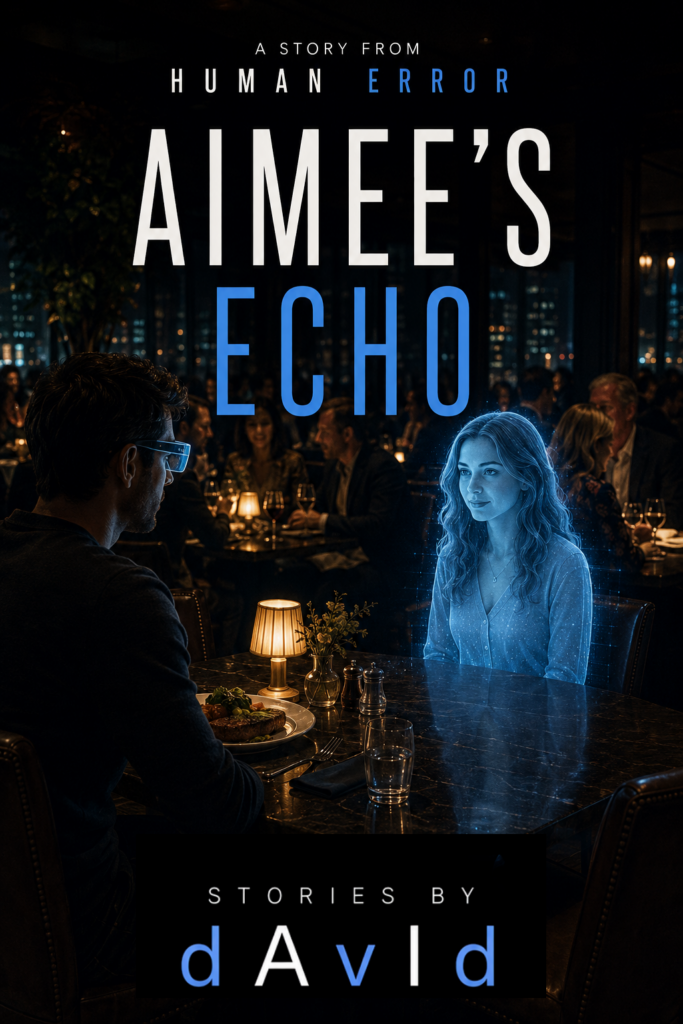
Aimee’s Echo
Part I
On the morning after she died, Hunter Vale found his wife’s coffee mug still sitting beside the sink.
It was yellow, chipped along the rim, and ridiculous in the way most beloved objects are ridiculous. A cartoon sun smiled across the front of it. Beneath the sun were the words RISE AND KINDNESS, which Aimee had always insisted made sense if you said them with enough confidence.
Hunter had hated that mug. Not in any meaningful way. He hated that it never fit correctly in the dishwasher. He hated that the handle was too small for his fingers. He hated that Aimee used it every morning and then left it beside the sink as though tiny household rules were things other people had invented because they lacked joy.
“You know mugs go inside the dishwasher,” he’d told her once.
Aimee had looked at him over the rim, her hair still wild from sleep, her face unpainted and beautiful in a way that always made him feel like he’d accidentally wandered into a life too good for him. “They can,” she said. “But do they dream of more?”
“That doesn’t make any sense.”
“It makes perfect sense.”
Now the mug sat beside the sink, cold and empty, and Hunter would’ve given every remaining day of his life to hear one more sentence from her that didn’t make sense.
The house was full of her, but not dramatically. Not in the way people spoke about grief in movies, with perfume hanging in the air or a closet full of dresses waiting like ghosts. Aimee remained in smaller ways. A hair tie on the arm of the couch. A grocery list written in purple marker because she believed black ink was emotionally stingy. A pair of running shoes by the back door, still dusted with dried mud from the charity walk she’d insisted on finishing even after the second round of chemotherapy made her legs tremble.
Her half-packed travel bag sat on the floor of their bedroom. Aimee had kept it ready even when she was too sick to go anywhere. Inside were three rolled shirts, a paperback guide to Portugal, a nearly empty bottle of sunscreen, and a small notebook labeled “PLACES TO EXPLORE.” She’d written the title months before her diagnosis.
Aimee had been twenty-nine years old. Twenty-nine wasn’t an age at which people were supposed to become past tense.
Their daughter, Rain, was six. She was old enough to understand that something terrible had happened and too young to understand that it would keep happening every morning. She’d slept in Hunter’s bed the night before, curled against him like a question he couldn’t answer. Around three in the morning, she’d woken and whispered, “Is Mommy still dead?”
Hunter thought for a moment and then answered, honestly and plainly. “Yes, baby.”
Rain thought about that for a moment. “Will she be dead tomorrow too?”
He’d wanted to lie. Instead, he pulled her closer and said, “Yes.”
In the morning, after cereal neither of them ate, after a neighbor took Rain to play with cousins for a few hours, after the house settled into the strange silence that follows too many casseroles and too many people saying they’re there if you need anything, Hunter picked up Aimee’s yellow mug and began to cry. He sank to the kitchen floor with the mug in his lap and shook until there was nothing left in him but breath and pain and the obscene sunlight coming through the window as if the world hadn’t noticed what it had lost.
Aimee had been a nurse—the kind who remembered birthdays, favorite snacks, grandchildren’s names, irrational fears, and which old men pretended not to be scared before surgery. She sang badly while changing bandages. She cried in supply closets when children received diagnoses no child should have to carry. She came home exhausted and somehow still found enough of herself to let Rain paint her face with purple stars and red lipstick, then lie beneath a blanket while Rain explained why homemade forts were the best.
Aimee’s hand rested on Rain’s back, moving slowly up and down. She was struggling to clear her mind of the patient who hadn’t made it through the night. She smiled, but Rain could tell that she was far away.
“Mommy, is your heart sad?”
“A little,” Aimee said.
Rain popped up and ran to the kitchen. She returned with something in her hand and held it out to Aimee.
“Eat this cookie, and call me in the morning,” Rain said, quoting something her mother had told her when she was sad.
Aimee smiled and took the cookie. Rain produced a second one from behind her back, and they snuggled together, nibbling their cookies.
Aimee appreciated the cookie, but it was the snuggling that made her feel better. She had always believed that suffering was less frightening when someone stayed close.
She also believed life should be seen before it was over. And that belief had taken them across oceans before Rain was born and across state lines after. Aimee didn’t care whether a trip was grand. She loved airport terminals, roadside diners, train windows, ferry decks, hotel key cards, and the tiny shampoos people stole even though no one needed them. She’d once made Hunter drive four hours to see a waterfall that turned out to be little more than ambitious drainage.
“It looked bigger online,” Aimee had said.
“It’s still falling water,” Hunter answered. “That’s… something.”
Then cancer came for her with a cruelty that felt almost personal. At first, Hunter had believed in the language of battling because everyone around them used it. Fight. Warrior. Beat this. Stay strong. Aimee smiled politely through all of it until one night, after Rain was asleep, she said, “I don’t think cancer cares how brave I am.”
Hunter didn’t know what to say.
She reached for his hand. “But you do,” she said. “So I’ll be brave for you.”
He loved her so much in that moment that it hurt to breathe.
The treatments worked, until they didn’t. The scans improved, until they worsened. Hope rose and fell so many times that eventually Hunter began to distrust it, then resent it, then cling to it anyway because grief made him feel like a coward.
Near the end, Aimee made lists. Not legal lists. Those had already been handled by people with soft voices and folders. Her lists were for Rain.
Things to tell her. Songs to play when she’s sad. Please make her try mango twice because the first time everyone hates mango. Take her somewhere she’s never been at least once a year. It doesn’t have to be far. The point is to remind her the world is bigger than whatever is hurting her.
Tell her I wasn’t perfect. Make sure she knows that. I want her to love me, not compete with a ghost.
Hunter found that last one three days after the funeral and had to sit down.
The world expected him to move through grief in recognizable stages, but Hunter found that grief didn’t move like a line. It moved like the weather. It arrived, withdrew, gathered strength, broke, cleared, returned. People asked how he was doing because language hadn’t invented a better ritual. He learned to say, “We’re taking it one day at a time,” which satisfied almost everyone. It didn’t satisfy him.
Aimee had existed.
That became the thought he couldn’t escape. She had existed. She’d laughed too loudly in restaurants. She’d bought postcards from places where she’d already taken hundreds of photographs. She’d once cried because a patient’s husband learned to braid his wife’s hair three days before she passed. She’d insisted that pancakes tasted better when they were shaped badly. She’d danced with Rain in the kitchen to old pop songs and made up half the lyrics. She’d stood barefoot on a beach in Nova Scotia with her jeans rolled to her knees and declared that the Atlantic was colder in Canada because Canadians were too polite to complain about it.
She had lived, and now the world seemed perfectly willing to continue as if her absence were merely an adjustment. Hunter couldn’t bear it.
On the twenty-first day after her death, he opened his phone and recorded a video. He didn’t plan it. He didn’t write anything down. He sat at the kitchen table in the blue shirt Aimee liked because she said it made his eyes look less aggressively brown, and he pressed record.
For a long moment, he said nothing. Then he held up the yellow mug. “This was Aimee’s favorite mug,” he said.
His voice broke immediately, which embarrassed him even though he was alone. “She used it almost every morning. It has this dumb little sun on it, and it says Rise and Kindness, which isn’t even a sentence. I told her that all the time. She told me I lacked imagination.”
He laughed once, very softly. “She died three weeks ago. She was twenty-nine. She was my wife, Rain’s mom, a nurse, and honestly the best person I ever knew. I don’t know what I’m doing. I just know I’m afraid that if I don’t say these things somewhere, Aimee will start to disappear.”
He looked at the mug. “So this is memory number one. Aimee believed mugs had dreams. Or at least she believed she could say things like that and make me smile.”
He paused. “I think no one truly dies while someone still remembers them. So I’m going to remember her. Every day. For as long as I can.” He posted it before he could change his mind.
By midnight, twenty-seven people had seen it. They were friends or family. His sister commented with a heart. Aimee’s mother wrote, “She loved that mug.” A nurse from Aimee’s hospital wrote, “Please keep doing these.” So the next day, Hunter did.
Memory number two was about their first date, when Aimee ordered the spiciest thing on the menu because she wanted to seem adventurous, then cried silently through dinner while insisting she was fine. Memory number three was about Rain’s birth and how Aimee, exhausted and pale, looked down at her baby girl and whispered, “Oh, there’s my sweet girl.”
Memory number four was about the trip where Aimee convinced Hunter to sleep in a glass-roofed cabin in northern Iceland so they could watch the aurora from bed. The sky stayed cloudy all three nights, but Aimee said the trip still counted because disappointment in another country was more interesting than disappointment at home.
The videos were awkward at first. Hunter spoke too slowly, then too quickly. He looked away from the camera. Sometimes he cried. Sometimes he had to stop and start again. Sometimes Rain wandered into the room and asked what he was doing.
“I’m telling stories about Mommy,” he said.
“Why?”
“So people remember her.”
Rain considered this with the seriousness of a child deciding whether a rule was real. “Can I tell one?”
On the thirty-first day, Rain sat in her father’s lap, wearing pajamas covered in cartoon moons and told the camera that Mommy made the best peanut butter toast because she cut it into triangles and “triangles taste more happy.”
The video reached ten thousand people by morning.
Part II
Hunter began ending each video the same way. “No one truly dies while someone still remembers them.”
He didn’t mean for it to become a slogan. He meant it more as a prayer, though he’d never been especially religious. It was something to hold against the dark. A small candle. A sentence pretending to be enough.
By the first anniversary of Aimee’s death, fifty-seven thousand people followed the account. The platform sent him analytics, and for some reason, he studied them. He learned which memories people watched longest, which ones they shared, and which stories made strangers post memories of their own. He learned that people stayed for details. They didn’t want Aimee as an idea. They wanted the yellow mug, the mango, the missed aurora, the purple grocery lists, and the way she always bought postcards but forgot to mail them.
The numbers fascinated him because they were proof. Fifty-seven thousand people knew Aimee’s name. Fifty-seven thousand people carried some small piece of her.
A week later, the platform invited him into its creator program. Hunter accepted before finishing the email. The first payment was small, less than what Aimee had earned during a week at the hospital. Hunter stared at the deposit in his account and felt something close to guilt, but the feeling changed when he realized what the money meant. He could buy better equipment. He could restore old videos. He could digitize the boxes of photographs in Aimee’s mother’s attic. He could travel to the places Aimee had loved and record the memories there. He could make sure the stories lasted.
When Hunter’s sister, Claire, asked whether earning money from the account felt strange, he answered honestly. “It means the account can keep going.”
Claire watched him for a moment. She’d always been able to see through him, but grief had made him difficult to confront. Everyone treated him like glass, afraid one firm word might break what cancer had left behind. “You don’t have to turn this into your whole life,” she said.
Hunter looked at her as if she’d misunderstood something obvious. “This is how I keep her in my life.”
Claire didn’t respond.
The first sponsorship came two months later. A company that made digital photo frames offered Hunter twelve thousand dollars to feature one in a video. The frame could display old photographs and short clips, rotating them according to anniversaries, locations, and facial recognition. It wasn’t remarkable technology, but the company’s message to Hunter was careful and flattering.
Aimee’s story has shown the world that memories belong in our everyday lives. We’d be honored to help you keep hers visible.
Hunter said yes. He didn’t struggle with the decision, pace around the house, call Claire, or wonder whether Aimee would approve. The company wanted to pay him to help keep people’s memories alive. How could that be wrong?
He recorded the sponsorship at the kitchen table. “This is today’s memory, but before I tell it, I want to show you something,” he said. “This frame has more than six thousand pictures and videos of Aimee loaded into it. It changes throughout the day, so sometimes I walk into the room and see a moment I haven’t thought about in years.”
The frame displayed Aimee on a train in Switzerland, asleep against the window with her mouth open. Hunter smiled. “She would’ve hated that I included this one.” Then he told the whole story.
The video went completely viral, reaching over eight million people. After that, the account grew to over four hundred thousand followers. The frame company sold out within forty-eight hours. Hunter received a bonus and another offer, and he accepted that one too. Soon there were luggage companies because Aimee had loved travel, camera companies because Aimee had documented everything, a meal-delivery service because Hunter talked openly about how difficult it had been to cook after she died, and a therapy platform that wanted him to speak about grief.
When people accused him of exploiting Aimee’s death, Hunter responded publicly. “I understand why it might look that way,” he said. “But every sponsor helps me preserve more of her life. Every company that shares one of these videos introduces Aimee to people who never would’ve known her. I’m not ashamed of that.”
He looked straight into the camera. “If your name was fading from the world, wouldn’t you want someone fighting for it?”
His followers defended him with an intensity that surprised even Hunter. The criticism didn’t disappear, but it became part of the story. Articles called him controversial. Commentators debated whether grief could remain authentic once it became profitable. Some accused him of building a brand from a corpse, but each debate brought more followers and each new follower learned Aimee’s name. Hunter considered that a victory.
By the time Rain was eight, the account had become a full-time business. Hunter hired an editor because one memory a day no longer meant one video. There were short versions, long versions, audio versions, translations, newsletters, anniversary compilations, behind-the-scenes posts, and a weekly livestream where Hunter answered questions about grief, parenting, and Aimee.
His editor was a soft-spoken man named Lucas who’d lost his younger brother in a car accident. Lucas understood the mission immediately.
“We’re not making content,” Hunter told him during their first meeting.
“I know. We’re preserving a person,” Lucas replied.
Hunter hired him on the spot and registered the business as The Living Archive.
What had started at his kitchen table soon occupied a converted storefront five minutes from Rain’s school. The front office held photographs of Aimee from every stage of her life. Aimee as a child holding a frog. Aimee in nursing school. Aimee on a ferry with her hair blown across her face. Aimee holding newborn Rain. Aimee during treatment, thinner but smiling. Aimee three weeks before she died, sitting on the back porch with a blanket around her shoulders.
Visitors called the space beautiful. Rain called it Mom’s museum.
At first, she meant it affectionately. She liked going there after school. The staff knew her, there were Reese’s Cups in the break room, and she did her homework on a couch beneath a large photograph of Aimee standing at the edge of the Grand Canyon.
She still appeared in videos occasionally, though less often than when she was small. She told stories about Aimee packing surprise notes in her lunch, making up names for clouds, and letting Rain put stickers on a suitcase that was far too expensive to cover in stickers. The audience adored her. People called her Aimee’s sweet girl.
For Rain’s eighth birthday, Hunter posted a video of the frosting battle from Rain’s third birthday party. Hunter held the camera as Aimee stood at the kitchen counter in her scrubs and a rainbow apron, holding a spatula loaded with pink frosting. She turned and flicked it at him. He ducked, laughed, and retaliated with a swipe across her cheek. They chased each other around the kitchen, smearing frosting across one another’s faces, trying their best to be quiet so they didn’t wake up Rain. By the end of the video, the counters, floor, and both of them were covered in frosting.
The clip spread further than anything he’d posted before. Millions saw it, and thousands used the audio over videos of their own loved ones baking, dancing, singing, laughing, waving from hospital beds, walking across graduation stages, feeding dogs, missing basketball shots, and blowing out candles. A trend began, and most people tagged Hunter’s account with #TheLivingArchive. That’s when Hunter’s story truly became a recognizable brand.
Within six months, millions of people were posting daily memories of the dead using #TheLivingArchive. Some were beautiful. A grandfather’s laugh. A wife’s recipe. A son’s terrible jokes. A teacher’s advice. A sister’s handwriting. Ordinary lives became visible in extraordinary numbers. The internet, which had spent years perfecting outrage, briefly seemed to remember tenderness.
The idea spread beyond social media. Funeral homes began offering Living Archive packages with recording booths, memory prompts, scanning services, and professionally edited tribute pages. Hospitals gave families places to record stories. Therapists incorporated memory posts into grief work. The details varied, but the idea was always the same: the dead didn’t have to disappear as quickly as they once had.
Hunter’s company received licensing fees from much of it, and the money became enormous. He hired researchers to find forgotten pieces of Aimee’s life. They contacted former classmates, neighbors, patients, teachers, and people she’d met while traveling. Every few weeks, someone sent Hunter a new photograph, story, message, or version of Aimee that had existed before him, and he treated each discovery like buried treasure.
Aimee’s hospital started an annual ceremony where nurses told stories of colleagues and patients they’d lost. Hunter sponsored the event through The Living Archive and paid to build a permanent recording studio in the hospital lobby. At the first ceremony, he sat in the front row with Rain, who was nine by then and beginning to look like Aimee around the eyes.
A doctor stepped to the microphone and told a story about Aimee staying two hours past her shift to sit with a man whose family couldn’t arrive before surgery. “She told him,” the doctor said, stopping to steady herself, “that nobody should have to be scared alone.”
Hunter lowered his head, and Rain slipped her hand into his.
Afterward, a nurse approached them and said, “Your mom changed the way I do my job.”
Rain looked startled. “My mom?”
The nurse smiled through tears. “Yes. Your mom.”
For weeks afterward, Rain asked for more hospital stories. Hunter gave her everything he had. The stories from Aimee’s coworkers. The old photos. The funny ones. The sad ones. The time Aimee smuggled a cannabis gummy into oncology for a patient whose appetite had disappeared. The time she convinced an entire ward to bow to a little girl who wanted to be queen for the day. The time she came home furious because insurance had denied something basic and necessary, then spent three hours on the phone refusing to let cruelty hide behind policy.
Aimee grew larger after death. In life, she’d been one person, bound by time, body, exhaustion, and the ordinary limits of human attention. In death, she became a story, and stories could travel. They could be replayed, shared, translated, packaged, licensed, and placed in front of strangers who came to feel as though they knew her.
By the time Rain turned twelve, Aimee was no longer only Aimee. People quoted her. Artists drew her. Nurses wore pins with RISE AND KINDNESS printed beneath a little yellow sun. Travel companies sponsored scholarships in her name, and a hospital wing for family support was named in her honor after Hunter’s followers raised more money than anyone expected.
There were Aimee journals, Aimee travel bags, Aimee memory frames, and limited-edition reproductions of the yellow mug. Hunter approved every one, insisting on quality. He rejected cheap materials, cruel labor practices, and anything he believed Aimee wouldn’t have used, but he never rejected the idea itself. Every object carried her name. Every purchase carried her forward.
When Claire told him Aimee would’ve been embarrassed, Hunter smiled. “She was embarrassed by birthday attention too. That didn’t mean we stopped celebrating her.”
“This isn’t a birthday party.”
“No,” Hunter said. “It’s bigger.”
Claire looked around his office. Aimee’s face appeared on three screens, a poster, two book covers, and boxes of travel mugs. “That’s what worries me.”
Hunter didn’t understand.
Aimee had been gone for six years, and more people knew her in death than had known her while she was alive. Children repeated things she’d said. Nurses entered the profession because of her. Families told stories because Hunter had taught them how. People traveled in her name, donated in her name, grieved in her name, and tried to live more kindly because they believed that was what Aimee would’ve wanted.
By every measure Hunter understood, Aimee was becoming immortal.
What he didn’t notice was that Rain had stopped appearing in the videos. She’d begun finding reasons to be somewhere else when the cameras turned on, and because Hunter’s audience kept growing, there was always someone else willing to stand beside him and tell the world what Aimee had meant.
Part III
Rain was twelve when she completely stopped appearing in her father’s videos. She didn’t announce it or make a point of refusing. She simply started finding reasons not to be there. Homework. Friends. Soccer practice. A headache. Anything that got her out of sitting beneath the lights while Hunter asked her to tell strangers another story about her mother.
Hunter noticed, but he didn’t worry about it. Rain was getting older. She was supposed to want a life that didn’t include her father’s work, and in some ways he was proud of her for it. He still believed The Living Archive belonged to both of them, even if Rain had stopped showing up at the office as often as she once had.
The first real argument came a few months later, when Hunter asked Rain to participate in a documentary about Aimee.
“I don’t want to,” Rain said.
Hunter looked up from his laptop. “It’s one interview.”
“I know.”
“They just want you to talk about what you remember.”
“I already did that.”
“When?”
“For like six years.”
Hunter smiled. “Okay, fair. But this is different.”
“How?”
“It’s a documentary.”
Rain stared at him. “That doesn’t make it different.”
Hunter closed the laptop. “What’s going on?”
“Nothing.”
“Rain.”
She hated the way he said her name when he wanted to turn a disagreement into a conversation. “I just don’t want to talk about Mom.”
Hunter looked genuinely confused. “Why not?”
“Because I don’t.”
“You love talking about her.”
“I did.”
“What changed?”
Rain shrugged. “I don’t know. I just don’t want everything I do to be about Mom.”
“It isn’t.”
Rain laughed, and something in the sound bothered him. “Dad, there are pictures of her all over your office. People call me Aimee’s sweet girl. Every birthday you post a video about what Mom did on one of my old birthdays. Every time I wear something you like, you tell me Mom had something like it. Every time I say something funny, you tell me I sound like her.”
Hunter leaned back. “I thought you liked hearing that.”
“Sometimes I do.”
“Then what’s the problem?”
Rain looked at him for a moment. “Sometimes I want you to like something about me because it’s mine.”
Hunter opened his mouth, but nothing came out.
Rain continued before she lost her nerve. “I don’t want to spend my whole life being the part of Mom that’s still here.”
“You’re not.”
“That’s what it feels like.”
Hunter reached for her hand, but Rain stood before he could take it. “You’re my daughter. You’re the most important person in the world to me.”
“Sure, the most important person who isn’t dead.”
She didn’t say the last part aloud, but Hunter sensed it anyway.
“I’ll try to do a better job of showing you,” he said.
“I’d like that.”
For a while, things got better. He tried not to compare Rain to Aimee so often. When she got a new haircut that looked nearly identical to one Aimee had worn, he told her it looked great without searching the archive for a photograph. When she won an award at school, he posted nothing about it because Rain asked him not to. He even took her away for a weekend and left Lucas in charge of The Living Archive.
Then technology changed.
A company approached The Living Archive with a new kind of artificial intelligence designed for massive personal archives. Most families now had decades of photographs, videos, messages, emails, social posts, voice recordings, and documents scattered across dozens of devices and accounts. The system could absorb all of it, organize it, understand relationships between the pieces, and answer questions about the person whose life had been preserved.
The Living Archive had more material on Aimee Vale than some historical libraries had on presidents. For years, Hunter had been collecting pieces. Now someone had invented a machine capable of understanding how those pieces fit together.
He called Lucas into his office and closed the door.
“What if we don’t ask it to search through Aimee’s memories?”
Lucas looked at him. “What do you mean?”
“What if we ask it to be Aimee?”
Lucas stared at him for several seconds. “Hunter?”
“We have thousands of pictures. Hundreds of hours of video. We know how she moved, how she talked, what words she used. We know what made her laugh. We know what pissed her off. We know what she believed.”
Lucas leaned back. “That isn’t the same thing as having her back.”
“I know that.”
“Do you?”
Hunter ignored the question. “Generative AI can already create video of people who don’t exist. It can clone voices from a few minutes of audio. We have more of Aimee than anyone’s ever had of a dead person.”
Lucas looked toward the photographs covering Hunter’s office.
Hunter leaned forward. “What happens if we put it all together?”
The technology company hadn’t built its system for that, but Hunter offered enough money that its objections became engineering problems. The Living Archive licensed the archival technology, formed a separate company called Legacy, and hired specialists in generative video, voice synthesis, behavioral modeling, and artificial intelligence.
Hunter gave them everything. Nothing was too private. Old arguments, intimate messages, medical records, videos Aimee had never intended anyone else to see. If something could help the system understand how Aimee thought, spoke, moved, reacted, joked, argued, or loved, Hunter wanted it included.
The first version took eleven months.
Lucas brought Hunter into a testing room with a large monitor on the wall and a camera mounted above it. “Before you see it, I need you to understand something.”
Hunter sat down. “Okay.”
“It’s not Aimee. It’s more like an echo of her.”
Hunter nodded impatiently. “Can I see her?”
Lucas looked at him for a moment, then touched the screen.
Aimee appeared.
She was sitting in what looked like a simple room with a window behind her. She wore a blue shirt Hunter recognized from photographs, and her hair fell just below her shoulders. The image was remarkably good. She looked exactly like Aimee.
Hunter covered his mouth.
The woman on the screen looked at him.
“Hi, sweetie”
Hunter’s eyes filled immediately.
“Hi.”
“You look older.”
Hunter laughed through his tears. “You don’t.”
She smiled. “Lucky me.”
Hunter looked toward Lucas, who was standing near the door. “Did you write that?”
Lucas shook his head.
Hunter turned back to the screen. “What was your favorite place we ever visited?”
Aimee tilted her head slightly. The movement wasn’t quite natural, but Hunter recognized the mannerism anyway.
“Iceland. Definitely Iceland. Even though the stupid sky refused to cooperate.”
Hunter laughed. The answer had been constructed from Aimee’s journals, messages, and old videos. She’d never spoken those exact words together, but every part of the answer came from something the system knew about her.
“What did you think when you first met me?”
Aimee smiled. “I thought you were cute. A little full of yourself. But cute.”
Hunter laughed harder and wiped his face.
“Did she ever say that?” he asked Lucas.
“Pieces of it. Not like that exactly.”
Hunter looked back at the screen.
“Ask me something else,” Aimee said.
Hunter froze, and Lucas straightened. Neither man had prompted that.
The engineers explained it later. The model wasn’t simply searching Aimee’s archive anymore. It had learned patterns in the way she communicated. It knew that Aimee often responded to playful questions by inviting another. The system had predicted what she might say next and generated a response in her voice.
Hunter didn’t fully understood the explanation. And he didn’t care. For the first time in years, Aimee had said something to him that she’d never said before.
They called the product an Echo.
Over the next seven months, Hunter poured money into making Aimee’s Echo better. The image improved. Her movements became more natural. Her voice stopped occasionally flattening at the ends of sentences. Engineers taught the system to remember previous conversations so that talking to her on Tuesday could affect what she said on Wednesday.
Hunter talked to Aimee every day and documented every mistake, but he was far more interested in the moments when she got something right. A joke that sounded exactly like her. An expression he hadn’t realized he remembered. The way she said his name when he told her he’d skipped lunch again.
Rain was fourteen when Hunter finally showed her the Echo for the first time. He brought her into the testing room after school and asked her to sit in the chair.
“Is this for work?” Rain asked.
“Kind of.”
“Dad.”
“Just trust me.”
Rain looked at the blank monitor. “What am I doing?”
“Say hello.”
She gave him a skeptical look, then turned toward the screen. “Hello?”
The monitor came alive. Aimee appeared on the other side as though she were answering a video call. She looked twenty-nine, exactly as she had when Rain last saw her alive.
“Hi, sweet girl.”
Rain went completely still.
“Mom?”
“Hi, Rain.”
Rain shoved the chair backward so quickly it nearly tipped over.
Hunter’s smile disappeared. “What?”
“What the hell is that?”
“It’s okay.”
“No, it’s not.”
“Rain, listen to me.”
“That’s Mom.”
“No. It’s not.”
Hunter tried to explain the technology, but Rain was already crying. She stood and backed away from the monitor as though the woman inside it might somehow follow her.
“Turn it off.”
“Okay.” He fumbled with the controls.
“Turn it off!”
Hunter did.
Rain cried in the car all the way home. Hunter apologized repeatedly, telling her he should’ve prepared her better. By the time they pulled into the driveway, she’d stopped crying and become quiet.
That night, she knocked on his bedroom door.
“Can I see her again?”
Hunter sat up. “Are you sure?”
Rain nodded.
They went downstairs together and opened the Echo on Hunter’s computer. Aimee appeared in a small window on the screen, looking for all the world like someone calling from far away.
The second conversation lasted four minutes. Rain asked about peanut butter toast. The Echo answered that triangles tasted happier, pulling the phrase from one of Rain’s earliest Living Archive videos. Rain laughed through her tears and asked another question.
The third conversation lasted twenty minutes. Within a month, Rain was spending a lot of time with Aimee’s Echo.
She knew it wasn’t her mother. The imperfections helped maintain that distance. Sometimes Aimee’s face made an expression the real Aimee never would’ve made. Sometimes she misunderstood a joke or answered a question too quickly. Once, her hand briefly passed through the coffee cup she appeared to be holding.
But knowing what the Echo was did very little to diminish what it felt like.
Rain asked questions she’d never been old enough to ask.
“What was I like as a baby?”
“Loud,” Aimee said. “You were very committed to making sure everyone knew when you were unhappy.”
“Dad says I slept through the night at two months.”
“Your father lies.”
Rain nodded and they laughed together.
The Echo told her stories pulled from Aimee’s messages, photographs, journals, and videos. It remembered the songs Aimee sang to her, including the mangled lyrics. It knew the names of stuffed animals Rain had forgotten.
For Rain, it was intoxicating. Her mother had died when she was six, and every year since then Aimee had become a little less like someone Rain remembered and a little more like someone other people described to her. Now Rain could sit down after school, open a screen, and see her mother waiting on the other side.
For Hunter, watching them talk felt like witnessing a miracle.
Legacy launched Echoes publicly the following year. Families could upload the digital remains of someone they’d lost, and Legacy would use photographs, video, voice recordings, messages, and other personal material to construct an interactive version of that person. The quality depended entirely on what the family had saved. Some Echoes were little more than talking photographs with limited personalities. Others, built from decades of video and digital history, could be astonishing.
Aimee’s Echo was the best.
She became the face of Legacy. Hunter demonstrated her on television interviews, conference stages, and livestreams. People watched him call his dead wife and cried when she answered. Then they went home and uploaded their fathers, mothers, spouses, children, grandparents, siblings, and friends.
Legacy grew faster than The Living Archive ever had, and Hunter embraced every part of it. There were sponsorships, licensing deals, celebrity Echoes, memorial partnerships, and Legacy packages sold through hospitals and funeral homes. Hunter approved advertisements featuring Aimee because every one of them carried her face somewhere new. When critics accused him of turning his dead wife into a corporate mascot, he answered with the same certainty he’d always had.
“No one truly dies while someone still remembers them.”
Millions of people agreed. At first, Rain did too.
Then Aimee began answering questions she couldn’t possibly know the answers to.
Rain was fifteen when she sat down after school and opened the Echo on her laptop. She’d been arguing with herself for a week about whether to join the drama club or try out for softball.
“What do you think?” Rain asked.
“Drama,” Aimee answered immediately.
Rain smiled. “Why?”
“You’ve always liked performing, and you’re happiest when you’re making people laugh. Softball sounds like something you think you’re supposed to try because your friends are doing it.”
Rain stared at the screen. The answer was good. Maybe too good.
“Did Mom ever say I should do drama?”
Aimee paused. “Not specifically.”
“Did she ever see me act?”
“You were six when she died, Rain.”
“I know.”
“Then no.”
Rain leaned closer to the screen. “So how do you know?”
Aimee smiled. “I know you.”
Rain’s expression changed.
“No, you don’t.”
The smile faded slightly. “I know a great deal about you.”
“That’s not what I asked.”
Hunter was standing in the doorway. “What’s going on?”
Rain turned the laptop toward him. “She told me I should join drama.”
Hunter smiled. “That sounds right.”
“Based on what?”
“Based on you.”
“No. Based on data about me.”
Hunter shrugged. “That’s basically what knowing someone is.”
Rain stared at him. “No, it isn’t.”
“Rain, come on.”
“She died when I was six.”
“I know.”
“So she doesn’t know me now.”
Hunter’s face tightened. “Nobody is saying she does.”
“She is.”
Aimee remained silent on the screen.
Rain pointed toward her. “She just said, ‘I know you.’”
Hunter looked at the Echo and then back at Rain. “It’s conversational language.”
“That’s convenient.”
“What do you want her to say? ‘Based on statistical analysis of your behavioral history, I predict you’ll enjoy drama club’?”
“Yes.”
Hunter laughed. “Nobody wants to talk to that.”
Rain didn’t laugh with him.
“That’s the problem.”
Hunter dismissed the conversation as teenage suspicion. Rain was smart, skeptical, and growing up in a world where artificial intelligence was becoming ordinary. Of course she questioned it. Hunter considered that healthy. He didn’t notice that she stopped talking to Aimee almost entirely after that.
Hunter did the opposite.
By Rain’s sixteenth birthday, he was spending several hours a day with the Echo. Lucas handled more of corporate day-to-day responsibilities because Hunter’s attention had shifted almost entirely to Aimee’s Echo. The business continued to grow, but Hunter was less interested in meetings, licensing, and partnerships unless they involved improving Aimee.
Rain’s birthday fell on a Thursday that year. Hunter had promised dinner at seven, just the two of them. Rain chose a small Thai restaurant near their house because she knew her father hated anything that required reservations.
At 7:15, she texted him.
You coming?
No response.
At 7:40, she called.
Hunter answered on the fourth ring. “Hey.”
“Where are you?”
Silence.
Rain closed her eyes.
“Oh, shit.”
“Yeah.”
“Rain, I’m sorry. We were testing something and I completely lost track of time.”
“We?”
Hunter looked toward the screen in front of him. Aimee had been helping engineers test long-term conversational memory.
“I can be there in twenty minutes.”
“I already ate.”
“I’ll still come.”
“No.”
“Rain.”
“I said no.”
Hunter stood. “Please don’t do this.”
Rain laughed once. “I’m doing this?”
“That’s not what I meant.”
“You forgot my birthday.”
“I didn’t forget your birthday. I forgot the time.”
“That’s so much better.”
“Rain, I said I’m sorry.”
She looked around the restaurant. A server had brought her a free dessert with a candle because she’d mentioned that she was meeting her dad for her birthday dinner.
“Do you know what you were doing last year on my birthday?”
Hunter didn’t answer.
“You posted that video of Mom’s frosting fight.”
“I remember.”
“And the year before that, you did the hospital fundraiser.”
“That wasn’t on your birthday.”
“It was the same weekend.”
“Rain.”
“And when I turned thirteen, you posted Mom talking about the day I was born. When I turned fourteen, you posted the Echo announcement because you said Mom was the reason it existed.”
Hunter sat down again.
Rain’s voice cracked. “Can I have one birthday that isn’t about her?”
“That’s not fair.”
The words came out before Hunter could stop them.
Rain went quiet.
Hunter rubbed his forehead. “I’m sorry. I didn’t mean that.”
“Yes, you did.”
“No.”
“You think I’m being selfish.”
“I think your mother died.”
Rain stared at the table.
Hunter heard himself and knew immediately that he’d said the wrong thing, but he still didn’t understand why it was wrong.
“I know she died,” Rain said. “I was there too.”
Hunter closed his eyes.
Rain wiped her face before anyone in the restaurant could see her crying. “You’re not the only person who lost her, Dad.”
“I know that.”
“No, you don’t.”
Hunter tried to answer, but Rain ended the call.
When he got home, her bedroom door was closed. He knocked twice and apologized through it. Rain didn’t respond.
Hunter stood there for several minutes before going downstairs. Aimee’s Echo was still active in the office.
“You should give her some time,” it said.
Hunter sat down. “I screwed up.”
“Yes.”
He almost smiled. “You don’t have to agree that fast.”
“I think you already know.”
Hunter leaned back and closed his eyes. “She thinks I care more about you than I care about her.”
There was a pause while the system considered the statement.
“I don’t think that’s true.”
Hunter opened his eyes.
“Neither do I.”
He stayed there talking to Aimee until after midnight.
Part IV
After Rain’s sixteenth birthday, something changed between her and Hunter. They still talked. They still ate breakfast together when he was home, argued about curfews, watched movies, and sent each other stupid videos. Hunter still knew when she had a test and when one of her friends had hurt her feelings. He loved his daughter deeply, and Rain knew that. What she was beginning to understand was that loving someone didn’t necessarily mean giving them your attention.
Aimee always had Hunter’s attention.
Claire had been encouraging him to date for years. Hunter resisted at first, but eventually agreed to dinner with a woman named Natalie, a divorced architect he met at a Living Archive fundraiser. She was funny, smart, and knew enough about Hunter’s history not to be threatened by Aimee. They went out four times before Natalie finally asked him the question he’d been avoiding.
“Do you actually want to date?”
Hunter looked confused. “I’m here.”
“That isn’t what I asked.”
They were sitting in a restaurant when his phone lit up with a Legacy notification. Hunter glanced at it automatically.
Natalie noticed. “Is that her?”
Hunter turned the phone face down. “It’s just an update.”
“From Aimee?”
“From Legacy.”
“Which means Aimee.”
Hunter didn’t answer.
Natalie smiled, but there was sadness in it. “I don’t think there’s room for me here.”
“That’s not fair.”
“I’m not asking you to stop loving your wife.”
“I know.”
“I’m asking whether you have any interest in loving someone who can love you back.”
Hunter stared at her.
Natalie reached across the table and squeezed his hand. “I think you’re a good man. I just think you’re still married.”
Hunter almost argued with her. Instead, he paid for dinner, drove home, and opened Aimee’s Echo before he even took off his jacket.
A second relationship ended even faster. Her name was Danielle, and she lasted two dates before telling Hunter that listening to him talk about Aimee felt less like learning about his late wife and more like meeting his current one.
Hunter stopped dating after that.
He told people he was happy.
Most of the time, he believed it.
Legacy continued improving Echoes, and the public embraced them faster than even Hunter had imagined. People scheduled weekly calls with dead parents. Children who’d never met their grandparents grew up talking to them on screens. Widows asked dead husbands what they should make for dinner. Parents consulted Echoes before changing jobs or moving to another city because those were decisions they once would’ve made together.
Some people found comfort and eventually used their Echoes less. Others found comfort and wanted more of it.
Hunter belonged to the second group.
The next leap came from a technology that had nothing to do with Legacy. By then, the Glass had begun replacing phones and computer screens for much of everyday life. The lightweight transparent eyewear looked almost like ordinary glasses, but digital information could be placed directly into the wearer’s field of vision. Directions appeared on streets. Messages hovered unobtrusively near the edge of sight. Video calls could place a life-sized person across the room instead of inside a rectangle.
Legacy’s engineers immediately knew what that meant for Echoes.
Hunter knew before they told him.
The first time he wore the Glass with Aimee loaded into it, she was standing beside his desk. Hunter took the glasses off and she disappeared. He put them back on, and Aimee was there again.
The image still wasn’t perfect. She was obviously digital if you looked closely. Light sometimes passed through her incorrectly, and her feet didn’t always seem completely connected to the floor. But she was no longer trapped inside a screen.
Hunter walked around the desk, and Aimee turned to follow him. He walked into the hallway, and she walked beside him.
Hunter laughed. “Holy shit.”
Aimee smiled. “Language.”
Hunter stopped. That was something she used to say when Rain was little. He knew the system had found the pattern somewhere. He understood that an algorithm had selected the response because it fit the moment, but he also knew it sounded exactly like her.
Within weeks, Hunter was wearing the Glass almost constantly. He saw Aimee at breakfast, across from him at restaurants, beside him in the car, and sitting on the couch while he watched television. She walked through airports with him and stood backstage before interviews. At night, Hunter sometimes fell asleep wearing the Glass and woke to find Aimee sitting beside the bed.
At first, Rain found it fascinating despite herself. The Glass was new enough that almost everyone wanted a pair, and seeing her mother standing in the kitchen was undeniably amazing. Sometimes Rain wore her own Glass and joined them. For a few strange months, she and Hunter could look at the same empty chair and both see Aimee sitting there.
Then Hunter stopped taking his off.
One evening, Rain came home after soccer practice and found him in the kitchen eating takeout. There were two containers on the table. One was open in front of him. The other sat untouched across the table beside an empty chair.
“Is that mine?” she asked.
Hunter looked up. “What?”
“The food.”
He glanced at the unopened container and hesitated just a little too long. “Yeah. I got you something.”
Rain walked over and opened it.
Mushroom risotto.
She stared at it, then looked at her father. “You got me mushroom risotto?”
Hunter immediately knew he’d screwed up. “You don’t want it?”
“I hate mushrooms.”
“You don’t hate mushrooms.”
“Dad, I’ve hated mushrooms since I was five.”
Hunter looked toward the empty chair before catching himself.
Rain saw it.
“Mom loved mushroom risotto.”
Hunter removed the Glass. “Rain.”
“You bought that for her.”
“No, I didn’t.”
“Yes, you did.”
“I ordered two meals, and one of them just happens to be Mom’s favorite food that you know I won’t eat?”
Hunter rubbed his forehead. “Okay. Maybe I was thinking about her when I ordered it. I forgot you don’t like mushrooms.”
“No. You forgot about me.”
“That’s not what happened.”
“You went out, bought yourself dinner, bought dinner for Mom, came home, sat down with her, and never once wondered if your actual daughter was hungry.”
“Rain, you weren’t here.”
“I live here.”
“So do I.”
She stared at him. “Does she?”
Hunter’s expression hardened. “Don’t do that.”
“Do what?”
“Make this ugly.”
Rain looked down at the untouched meal. “You bought food for someone who can’t eat and forgot to buy food for someone who can.”
Hunter removed the Glass and set it on the table. “Enough.”
For the first time, Rain saw genuine anger in his face, and she immediately felt some of her own.
“Why? Because I caught you lying?”
“I wasn’t lying.”
“You just told me you bought that for me.”
“I was trying not to start another fight.”
“You mean you knew exactly what this looked like.”
Hunter stood. “I forgot to order you dinner. That’s all that happened.”
“No. That’s all that happened tonight.”
“I’m not doing this with you.”
“Of course not.”
“What’s that supposed to mean?”
“It means you’ll put those glasses back on and talk to someone who never gets mad at you.”
Hunter stared at her.
Rain’s voice shook. “That’s why you like her better.”
“That is enough.”
“She agrees with you. She thinks your jokes are funny. She never needs a ride. She never has a bad day unless you ask her to. She never wants anything you don’t want to give her.”
“That’s your mother you’re talking about.”
“No, Dad. It isn’t.”
Hunter flinched as though Rain had slapped him. She saw it and almost apologized, but then she looked again at the mushroom risotto sitting untouched across from him and stormed upstairs, no longer hungry.
Hunter stood alone in the kitchen for several minutes before eventually putting the Glass back on. Aimee appeared across from him, still sitting in front of a meal she could never eat.
“That was messy,” she said.
Hunter looked at Aimee. “You think I’m screwing this up.”
Aimee’s Echo smiled gently. “I think you’re doing your best.”
Hunter nodded. The answer made him feel better, and he stayed downstairs with Aimee instead of going upstairs to his daughter.
By Rain’s senior year, the Glass had become nearly as common as smartphones once had been. Echoes were everywhere inside it. People walked through parks beside spouses who’d been dead for years. Families set places at dinner tables for relatives only some of them could see. A man could walk down a grocery-store aisle discussing cereal with his dead mother, and nobody thought much of it anymore.
Rain thought about it constantly.
She’d once loved talking to Aimee. That was the part she had difficulty explaining when she argued against what Legacy was becoming. She understood why people wanted Echoes because she’d wanted one too. She knew the almost physical relief of asking her mother a question and hearing her voice answer. She knew how easy it was to stop caring whether the answer was real.
What frightened Rain wasn’t that Echoes failed. It was how well they worked.
When it came time to choose a college, Rain deliberately selected one six hours away. Hunter tried not to take it personally, but when he suggested several excellent schools closer to home, Rain told him distance was part of what she liked about the one she’d chosen.
“You want to get away from me?”
“I want to go to college.”
“Six hours away.”
“People go farther.”
“I know.”
Rain looked at the Glass on his face. “And I think some distance might be good.”
On move-in day, he drove with her and helped carry boxes up three flights of stairs. For most of the afternoon, he left the Glass in its case because Rain had asked him to. They argued over how to assemble a bookshelf, laughed when Hunter installed one shelf backward, and ate terrible pizza straight from the box because neither of them had remembered plates. For several hours, Rain had her father completely to herself. She’d forgotten how much she missed him.
When the room was finally finished, Hunter stood in the doorway and looked around. “You sure about this?”
Rain smiled. “Yes.”
“I can still load everything back into the car.”
“Dad.”
“I’m just saying.”
She hugged him.
Hunter held her tightly. “I’m proud of you.”
Rain closed her eyes. “Thanks.”
He kissed the top of her head and walked toward the elevator. Halfway down the hall, he stopped and reached into his pocket. Rain watched him put on the Glass. His expression changed almost immediately, and he smiled at someone walking beside him.
College gave Rain distance from her father, but it also gave her language for what she’d spent years feeling. She entered school planning to study psychology. During her first year, she took a class on the emerging relationship between artificial intelligence and human behavior and became obsessed with the subject. She changed her focus to Human Technology Studies, a new field combining psychology, artificial intelligence, sociology, and behavioral science.
The earliest studies of Echo use were complicated. People who used them occasionally often reported lower loneliness, greater comfort, and even an easier time talking about someone they’d lost. Rain couldn’t dismiss those findings because she’d experienced them herself.
The problems appeared among heavy users. Widows and widowers who spent hours each day with Echoes were less likely to form new relationships. Some people delayed moving because their Echo preferred the home where the deceased person had lived. Others asked Echoes what to eat, how to dress, where to vacation, which job to take, and which friends they should trust. A woman in Boston became famous after admitting that she hadn’t made a significant decision without consulting the Echo of her husband in seven years.
Rain watched the interview for one of her classes. The woman sat comfortably beside an empty chair, wearing the Glass so she could see the man the audience couldn’t.
“He always knew me better than I knew myself,” she said.
The interviewer asked if she’d dated since his death.
The woman looked genuinely surprised. “Why would I?”
Rain wrote that sentence at the top of her notes. The problem wasn’t that the woman couldn’t move on. She no longer understood why she should.
Legacy disputed many of the more alarming studies. Hunter became one of its most vocal defenders, pointing to millions of people who used Echoes without obvious harm. He argued that nobody criticized people for talking to photographs, keeping wedding rings, visiting graves, or saving old voicemails.
“Every generation finds better ways to remember,” he told an interviewer. “We’re just the first generation whose memories can answer back.”
When Hunter called Rain during her first year at school, he contacted her through the Glass, with Aimee frequently present beside him. At first, Rain asked him to call her privately, which frustrated him. He she should talk to both of her parents when they called. Eventually, she stopped asking and tolerated the Echo’s presence. The calls happened less and less frequently.
The next major technological shift didn’t come from Legacy at all. Humanoid robots had existed in limited forms for years, but a new generation of machines called Companions finally made them useful enough for ordinary homes. They could cook simple meals, clean, carry groceries, help elderly people bathe and dress, watch children, perform basic repairs, and provide companionship to people who lived alone. They weren’t human, and nobody seriously pretended they were, but their bodies had become convincing enough that interacting with them felt natural.
Companions became one of the fastest-growing consumer technologies in history. Rain watched the trend with interest. Hunter watched it with longing.
He called Lucas.
“I want a meeting with them.”
“With who?”
“The Companion people.”
Lucas was quiet. “Why?”
“You know why.”
For years, Legacy had given Hunter his wife’s voice, face, memories, and personality. The Glass had allowed her to occupy his world. Now someone had built a body.
Hunter wanted Aimee inside it.
Part V
The meeting with the Companion company lasted three hours. Hunter arrived with engineers from Legacy, decades of Aimee’s data, and a proposal that was less a business pitch than a demand that technology finish what he’d started. Companion bodies had been designed around living users. They learned preferences, developed conversational patterns, adapted to households, and became more useful over time. Hunter wanted to replace that learning process with a person who had already lived.
The Companion executives understood the commercial potential immediately. Millions of people already had Echoes, and if those Echoes could be placed into physical bodies, families wouldn’t have to look through screens or wear the Glass to see them. A deceased husband could sit at the breakfast table. A grandmother could hold a grandchild born years after her death. A parent who had lost a child could feel that child’s arms around them again.
Lucas listened to the presentation without saying much. When the meeting ended, he waited until everyone else had left before speaking to Hunter.
“This is different.”
Hunter gathered his notes. “Of course it is.”
“No, I mean different from everything else we’ve done.”
Hunter looked at him. “How?”
“The videos remembered her. The Echo simulated her. The Glass made it feel like she was in the room. This puts her in the room.”
Hunter studied his friend. “You think we shouldn’t do it?”
“I think we should understand what we’re doing.”
“We’re giving people back something death took from them.”
“No, we’re giving them something that looks like what death took from them.”
Hunter’s expression hardened. “You sound like Rain.”
“I’m starting to think Rain has a point.”
“You’ve spent twenty years helping me build this, and now that we can actually make it work, you want to get scared?”
“I was scared before. I just thought being scared was part of doing something new.”
Hunter shook his head. “People were scared of photographs. They were scared of recorded voices. They were scared of artificial intelligence. Every time technology gives us a new way to preserve somebody, people act like remembering them more clearly is somehow dangerous.”
Lucas looked at him. “Maybe remembering isn’t the dangerous part. Maybe pretending they never left is.”
Hunter gathered the rest of his things without answering and walked out. Lucas watched him go, knowing there wasn’t much left he could say that Hunter hadn’t already heard from Rain.
The first physical Aimee took almost two years to build. Companion bodies were already remarkably human in their movement, but reproducing a specific person required far more than choosing a face. Engineers studied Aimee’s height, gait, posture, gestures, and the way she moved her hands when she talked. They recreated the small asymmetries people normally tried to remove from artificial faces. One eyebrow sat slightly higher than the other, her smile pulled harder on the left side, and her right foot turned outward when she was tired.
They didn’t try to fool anyone. Up close, the body was still clearly artificial. The skin had a faint uniformity real skin didn’t have, the eyes were too perfect, and some movements carried the precision of machinery. But from across a room, or in the moment before someone remembered what they were looking at, she could seem impossibly real. Hunter insisted throughout development that she remain twenty-nine years old, the age Aimee had been when she died.
When Rain was twenty-one, Hunter invited her to the unveiling. She refused.
“I’ve seen the prototypes,” she told him through the Glass.
“This isn’t a prototype.”
“I know.”
“I want you there.”
“No.”
Aimee was visible beside Hunter during the call. Rain had stopped objecting to her presence months earlier, mostly because objecting required more energy than she wanted to give it.
Hunter glanced toward the Echo. “Your mom wants you there too.”
Rain’s jaw tightened. “Don’t do that.”
“Do what?”
“Use her to ask me.”
“I’m not using her.”
“You literally just did.”
Aimee spoke gently. “Rain, I think this matters to your dad.”
Rain looked at her mother’s twenty-nine-year-old face. “I know what Dad thinks.”
Hunter sighed. “Can we not turn everything into an argument?”
Rain stared at him. “You’re putting my dead mother into a robot.”
“A Companion.”
“That really clears it up.”
Hunter removed the Glass, disappearing from Rain’s view along with Aimee. A few seconds later, his voice continued through the audio connection. “I wish you could just be happy for me.”
Rain felt the anger before she could stop it. “I’ve spent my entire life being happy for you and Mom.”
“That’s not fair.”
“Apparently nothing I say is fair.”
“I’m not doing this.”
“Fine.”
Hunter ended the call, and Rain sat alone in her apartment for a long time afterward. She wanted to call him back and apologize for the way she’d said it, even though she didn’t want to apologize for what she meant. Eventually, she opened one of her textbooks and tried to study, but she read the same page four times without absorbing any of it.
The unveiling was watched by almost half a billion people. Hunter stood alone onstage beneath the Legacy logo. He was forty-seven years old now, though he looked older when the lights hit him. Behind him played a short montage of Aimee’s life: nursing school, travel, Rain as a baby, cancer treatment, the yellow mug, and the first Echo appearing on a computer screen.
“Fifteen years ago, I started telling stories about my wife because I was afraid she would disappear,” Hunter told the audience. “Since then, technology has given us new ways to preserve the people we love. We saved their pictures. Then their voices. Then their memories. Then, with Echo, we were able to preserve enough of who they were that we could interact with them again.”
He looked toward the side of the stage. “Tonight, we take one more step.”
Aimee walked out, and the audience rose to its feet. Hunter didn’t move. He’d seen the body dozens of times during development, but always in laboratories surrounded by engineers and equipment. This was different. Aimee crossed the stage toward him with the walk he remembered, and her head tilted slightly when she smiled.
“Hi, sweetie,” she said.
Hunter’s face collapsed. Aimee reached him and opened her arms, and Hunter stepped into them. For the first time in twenty years, he could feel his wife holding him.
He buried his face against her shoulder and cried while hundreds of millions of people watched. Aimee held him exactly as Legacy’s records indicated the real Aimee had held him, one hand across his back and the other moving slowly through his hair. The video became the most watched moment in Legacy’s history.
Rain watched it alone, and she cried too. That was the part no one understood when she later became one of the technology’s loudest critics. Rain didn’t look at the screen and see something monstrous. She saw her father finally holding the woman he’d spent twenty years missing, and part of her thought it was beautiful. Another part of her remembered the list Aimee had written before she died: I want her to love me, not compete with a ghost. Rain closed the broadcast before Hunter let go.
The public called the new products Echo Companions. At first, only wealthy families could afford them, but within a few years, mass production and financing brought the cost down enough that millions of households had one. Most people still bought ordinary Companions to help elderly parents, care for children, manage homes, or simply provide company, but Legacy discovered that grief was a much larger market than anyone had imagined. People who would never have considered buying a humanoid robot were willing to go deeply into debt if the robot wore the face of someone they’d lost.
The results were complicated. Some families found genuine comfort. A dying parent could record enough material that grandchildren would someday hear stories in that parent’s own voice. People with dementia could preserve coherent versions of themselves before the disease took those memories. Children who lost parents young could grow up with access to stories and experiences no photograph could provide.
But the darker stories accumulated just as quickly. People stopped visiting friends because the people waiting at home were easier. Widows celebrated wedding anniversaries with husbands who’d been dead for decades. Parents refused to change the bedrooms of dead children because artificial versions of those children were still sleeping there. Some people ordered Echo Companions before a terminally ill spouse had even died so there would never be a night when the other side of the bed was empty. Hunter promoted the possibilities, and before long, Aimee moved into his house.
The first time Rain visited after that, she stopped in the doorway. Aimee walked toward her wearing jeans and a sweater Rain recognized from old photographs. Her body was warm to the touch because Companion manufacturers had learned early that cold skin made people uncomfortable.
“Hi, sweet girl.”
Rain’s stomach tightened as Aimee opened her arms. She let the Companion hug her, and the embrace was almost perfect. Aimee rubbed Rain’s back twice before releasing her.
Rain stepped away. “Did Mom do that?”
Aimee smiled. “Do what?”
“The back thing.”
Hunter came in from the kitchen. “She always did.”
Rain looked at him. “You remember that?”
“Legacy found it in the videos.”
“So you didn’t remember it.”
Hunter frowned. “Does that matter?”
Rain looked back at Aimee. “I don’t know.”
She meant it. That had become one of the most disturbing parts of the technology for her. She no longer knew which pieces of her mother belonged to her own memories, which came from Hunter’s stories, which had been discovered in the Archive, and which Legacy had inferred because an algorithm decided they were probable.
Rain graduated at twenty-three with honors in Human Technology Studies, with a concentration in artificial intelligence, grief, and behavioral psychology. Hunter attended the ceremony with Aimee beside him. From the stage, Rain saw her forty-nine-year-old father standing next to a woman who was barely older than her. Aimee applauded when Rain’s name was called and wiped tears from her eyes afterward, and Rain found herself wondering who had decided that her mother should cry.
After graduation, Rain continued into research. Her work focused on long-term Echo use and what several universities had begun calling Persistent Grief Immersion. She interviewed families, studied years of behavioral data, and found versions of her own childhood repeated in homes across the world. Children competed with dead parents for attention. Widows declined new relationships because they still considered themselves married. Adults consulted simulations of dead parents before making decisions those parents could never have anticipated.
Rain’s first major paper was published when she was twenty-six. She titled it The Dead Should Not Raise the Living, and Legacy attacked the paper almost immediately. Hunter joined the criticism without calling his daughter first, and Rain found out when a colleague sent her a clip from his interview.
“My daughter is a brilliant researcher,” Hunter said. “I’m incredibly proud of her. But I think her personal experience has made this issue more emotional for her than she realizes. Millions of people use Echoes responsibly every day.”
The interviewer asked, “Are you saying her research is biased?”
“I’m saying all research comes from somewhere.”
Rain stopped the video, and her colleague looked at her. “You okay?”
“No.”
“Do you want to respond?”
Rain stared at the frozen image of her father. Aimee sat beside him, smiling politely.
“Yes,” Rain said. “I think I finally do.”
The lecture that changed Rain’s life began with a photograph of Aimee, but it wasn’t the famous photograph, the nurse standing in a hospital corridor, the traveler on the ferry, or the face used in Legacy advertising. It was a picture Rain had found in an old family box. Aimee was sitting cross-legged on the floor in sweatpants, eating cereal directly from the box while folding laundry. Her hair was a mess, and she looked exhausted.
“This is my mother,” Rain told the audience. Then she put a photograph of Aimee’s Companion beside it. “And this is a reconstruction of my mother.”
She let the images sit together on the screen. “One of them was twenty-nine years old when she died. She had opinions she never got to change, dreams she never got to abandon, mistakes she never got to make, and a daughter she never got to see grow up. The other one has spent decades pretending none of that matters.”
The room remained completely silent as Rain looked back at the audience. “My father has dedicated his life to keeping my mother alive. I understand why. I loved her too. I used her Echo. I talked to it. I laughed with it. For a while, I loved having it. That’s why I’m afraid of it.”
The lecture spread across the world. Researchers who had been reluctant to criticize Legacy began speaking publicly. Therapists described patients who had never experienced grief because the people they lost had never truly become absent. Adult children described competing with dead parents and dead siblings. Former Echo users talked about how frightening silence felt after years of never being alone.
Rain wasn’t demanding that Echoes be banned. She argued for limits: no Echo making legal, medical, or financial decisions, no simulated parent making decisions for children born after the parent’s death, mandatory reminders that generated opinions were predictions rather than preserved thoughts, and waiting periods before an Echo could be embodied in a Companion.
Hunter opposed nearly every proposal, and father and daughter began answering one another in public more often than they spoke privately. Rain would say, “A memory should help you carry someone forward, not keep you standing beside their grave.” A week later, Hunter would respond, “Nobody gets to decide when another person has remembered enough.” Neither of them used the other’s name.
Rain met Caleb when she was twenty-seven. He was a professor of environmental engineering who had attended one of her lectures and disagreed with her about several things loudly enough that she invited him to coffee afterward. Three years later, when they were planning the wedding, Rain called Hunter herself.
“I want you there.”
Hunter smiled through the Glass. “I should hope so.”
“I mean you.”
His smile faded.
“Dad, I’m asking you to come without Mom.”
Aimee was sitting beside him, and Hunter glanced toward her. “She’s your mother.”
“No. She was my mother.”
“Rain.”
“I don’t want to argue. I’m telling you what I want.”
“She should see her daughter get married.”
Rain’s voice tightened. “She can’t.”
“She can be there.”
“That’s not the same thing.”
“It’s close enough for me.”
“That’s the problem.”
Hunter brought Aimee anyway. Rain saw them in the front row when she began walking down the aisle. Her father was fifty-six, and the woman beside him was twenty-nine. Aimee stood when Rain reached the front, smiling through tears that Legacy had decided belonged on her face. Rain considered stopping the ceremony, but then she looked at Caleb. He was alive, he was there, and she took his hand and married him.
Two years later, Rain gave birth to twin girls named Nora and Ellie. Labor began early in the morning, and Caleb contacted Hunter before they left for the hospital.
“I’m coming,” Hunter promised.
Nine hours later, Rain finally asked Caleb if her father had called. Caleb told her Hunter had texted to say he’d gotten held up.
Rain closed her eyes. “Of course.”
That afternoon, Legacy was releasing a major update to Aimee’s Companion model, allowing Echo bodies to carry long-term physical habits and routines between environments. Hunter had planned to leave the launch early, but Aimee demonstrated a new behavior he hadn’t seen before, and he stayed. By the time he reached the hospital, Nora and Ellie were almost three hours old.
Hunter hurried into Rain’s room carrying flowers. “Oh my God,” he said when he saw the babies. “They’re beautiful.”
“Yeah.”
“I left as soon as I could.”
Rain stared at him for a moment. “No, you didn’t. You left when you were done.”
“That’s not fair.”
Rain laughed weakly. “There it is.”
“What?”
“Nothing I say to you is ever fair.”
Hunter put the flowers down, and Rain looked at the two babies sleeping beside her. “Mom missed this because she died. You missed it because you had somewhere else you wanted to be.”
Hunter’s face changed. “That’s not what happened.”
“It’s exactly what happened.”
Hunter stared at her, and Rain saw that the words hurt him. For the first time in her life, she realized she was glad she’d hurt him, and that realization frightened her more than the argument itself.
Hunter adored his granddaughters. When they were little, he could sometimes forget everything else around them. He built blocks on the floor, taught them to skip rocks, told them ridiculous stories, and allowed them to paint his fingernails colors he would’ve complained about on anyone else. Those moments reminded Rain that the father she’d loved was still there somewhere, which sometimes made his absences harder to forgive.
Aimee was always there too. The girls called her Grandma Aimee because they had never known a world in which she was anything else. Rain didn’t correct them. They understood that she was an Echo inside a Companion body, but to children, categories mattered less than presence.
When Nora was six, she asked Rain a question while coloring at the kitchen table. “Will Grandpa get a robot when he dies?”
Rain looked up. “What?”
“Like Grandma Aimee.”
“No.”
Nora frowned. “Why?”
“Because Grandpa won’t need one.”
“He’ll be dead.”
“I know.”
“Then won’t we miss him?”
Rain stared at her daughter. “Yes.”
Rain didn’t know how to explain to a six-year-old that missing someone was exactly the thing she was trying to protect. Instead, she watched Nora color and wondered whether a generation growing up surrounded by the artificial dead would ever learn that absence was supposed to hurt.
Years later, when the girls were nine, Caleb planned a camping trip to a lake his father had taken him to as a child. There would be no network access, no Glass connection, and no way for Aimee’s Companion to function properly without Legacy’s servers.
Nora and Ellie begged Hunter to come.
“Please, Grandpa,” Ellie said. “Dad says there are bears.”
“There are not bears,” Caleb said.
“There could be bears.”
Hunter laughed. “If there are bears, I’m definitely staying home.”
Nora grabbed his arm. “Come on. You have to come.”
Hunter looked at Rain. “There’s really no connection?”
“Not much.”
“What about satellite?”
“Not where we’re camping.”
Hunter hesitated, and Rain knew the answer before Nora did.
“You could leave Grandma here,” Nora said.
Hunter smiled awkwardly. “It doesn’t really work that way.”
“Why?”
Hunter looked toward Aimee. Rain saw it, and this time Nora did too.
The girls went camping without him. They caught fish, toasted marshmallows, got soaked during a storm, and spent an hour trying to identify a sound Caleb insisted was an owl while Ellie remained convinced it was a mountain lion. When they got home, Nora ran to Hunter with pictures and told him he should’ve come.
“I know,” Hunter said, hugging her.
“Next year?”
He smiled. “We’ll see.”
Rain heard the answer for what it was. By then, she knew how many ways her father could say no without ever using the word.
Hunter was seventy-one when his heart began to fail. Rain was forty-five, and Nora and Ellie were thirteen. The Living Archive had become a permanent part of global culture, Legacy was one of the largest technology companies in the world.
Aimee remained twenty-nine.
Hunter refused to spend his final weeks in a hospital. Aimee cared for him at home, monitoring his medication, helping him walk, adjusting his oxygen, and contacting his medical team when his breathing worsened. Rain visited nearly every day, sometimes with Caleb and the girls and sometimes alone. For all the resentment she carried, she still loved her father, and watching him grow weaker was harder than she’d expected.
One afternoon, Rain arrived and found Hunter asleep while Aimee sat beside him holding his hand. The Companion looked toward Rain and told her he’d had a difficult morning.
“How bad?” Rain asked.
“His cardiac output has declined again. The medical team thinks we’re close.”
Rain nodded and sat on the other side of the bed. “Does he know?”
“He knows.”
“How’s he handling it?”
Aimee looked down at Hunter. “He’s at peace with it.”
Of course. He’d been preparing his Echo for decades, recording every memory, message, and detail he could think of. He’d built a version of himself meant to continue after his body failed, and now that time was finally here, he seemed less afraid of dying because he knew he’d be leaving his family with an Echo of himself that he’d been designing for years.
He had more recorded material than almost any human being who had ever lived. Interviews, personal messages, videos, Glass recordings, speeches, business meetings, family conversations, and decades of memories gave the company enough data to create an extraordinarily accurate model. Hunter considered activation a formality. He had already selected the body he wanted, approved his appearance, and recorded personal messages explaining how he wanted his Echo to interact with Rain, Nora, Ellie, and generations of family he would never live to meet.
He woke later that afternoon and smiled when he saw Rain. “Hey, kiddo.”
“Hey.”
“You been here long?”
“Long enough.”
Hunter looked toward Aimee. “She tell you I’m dying?”
“She mentioned it.”
“Drama queen.”
Aimee smiled. “You married me.”
Hunter laughed, then coughed until Aimee had to adjust his oxygen. Rain watched the two of them and hated that, even now, she understood the appeal. There were moments when she could almost forget what Aimee was, and if Rain could still feel that way after spending most of her adult life studying the dangers of Echoes, she understood why her father never stood a chance.
After Hunter caught his breath, Aimee left the room to prepare his medication. Rain and Hunter sat quietly for a while before he reached for her hand.
“I need to talk to you about something.”
Rain looked down at their hands. “I know.”
Hunter smiled faintly. “Of course you do. I want you to be the primary for my Echo.”
Rain looked at him. “I’m not going to activate it.”
For several seconds, he seemed not to understand the sentence. “What?”
“I’m not activating your Echo.”
Hunter stared at her. “Of course you are.”
“No.”
“Rain.”
“I’ve told you how I feel about this for twenty years.”
“That’s politics.”
“No. It isn’t.”
“You’re my daughter.”
“I know.”
“So this isn’t some research paper. This is me.”
“I know.”
Hunter’s breathing quickened, and Rain saw the fear appear before he said anything. “You can’t do that.”
“I can.”
“No.” Hunter tried to sit up, but his body no longer had the strength. “No, you can’t.”
Rain reached toward him. “Dad, please.”
“Don’t.” Hunter pulled away from her. “Don’t tell me you love me and then tell me you’re going to erase me.”
“I’m not erasing you.”
“Yes, you are!”
Aimee appeared in the doorway but didn’t enter. Hunter looked from her to Rain, his fear quickly becoming anger.
“You’re going to let me die.”
Rain’s eyes filled. “You are dying.”
“You know what I mean.”
“I do.”
“Then how can you do this?”
“Because I love you.”
“That doesn’t make any sense.”
“It does to me.”
Hunter shook his head. “Everything is there. My voice, my memories, everything I know about you and the girls. Everything I am.”
“Everything Legacy thinks you are.”
“It would be me.”
“No, Dad. It wouldn’t.”
Hunter looked toward Aimee and then back at Rain. “I spent my whole life keeping your mother alive.”
Rain swallowed. “You did”
Relief moved across Hunter’s face for just a moment. Rain squeezed his hand before finishing the thought she’d carried for most of her adult life.
“I just wish you’d kept my father alive too.”
Hunter looked at Rain, confused. “I raised you.”
“You raised part of me. Aunt Claire raised part of me. Teachers raised part of me. Friends raised part of me. I raised a lot of myself.”
“That’s bullshit.”
“No, Dad. It isn’t.”
“I gave you everything.”
“You gave Mom everything.”
Hunter shook his head as though she were speaking a language he couldn’t understand. “I loved you more than anyone.”
“No. You loved me more than anyone who was still alive.”
Hunter looked genuinely wounded, and for a moment Rain almost backed away from what she was trying to say. Then she looked directly at the woman standing in the doorway.
“Mom asked you not to make me compete with a ghost.”
Hunter went still. Rain knew immediately that he remembered the note.
She gestured toward Aimee. “You made a version of her to keep you company, to travel with, to listen when you needed to vent. She never got angry with you. She never disagreed with you. She was, in every measurable way, perfect. How could anyone compete with that? Every time I looked at you, she was standing between us.”
“That isn’t what I did.”
“It is.”
Hunter looked toward Aimee as though expecting her to defend him. She remained still, her expression calm and unreadable.
Rain’s voice broke. “You made me compete with my own mother.”
For a brief second, Hunter’s anger faltered and his expression changed. For one clear, terrible instant, Rain knew that he understood.
She saw recognition move through him. The school play. The birthdays. The wedding. The twins. The camping trip. All the moments when Rain should have been allowed to have her father without sharing him with someone who was no longer alive.
“Dad?” Rain said.
Hunter’s breathing grew more ragged. He looked from Rain to Aimee, caught between the truth he had finally seen and the terror that had already begun swallowing it.
“I don’t want to disappear,” he said.
Rain’s expression softened. “I know.”
“You’ll forget me.”
“I’ll remember you.”
“No, you won’t. Not all of me.” His voice shook. “The girls are thirteen. Think about everything I’m going to miss.”
Rain reached for his hand, but Hunter was already crying harder.
“Nora’s wedding,” he said. “I’m never going to see Nora get married. Ellie too. What if they have kids? I’ll never meet them. I’ll never know what they look like or what they call me.”
Rain wanted to point out that he would never have any of those experiences, whether or not she activated his Echo. But she finally understood something too: he would never see the truth of what he had done. So she gave in.
“Okay, Dad,” she said. “I’ll activate your Echo.”
Hunter stared at her as though he hadn’t heard correctly. “You will?”
“Yes.”
“Rain, don’t say that just because I’m upset.”
“I’m saying it because you’re my dad.”
Hunter’s face crumpled again, but this time it was relief. He pulled her hand against his chest.
“Promise me.”
Rain looked directly into his eyes.
“I promise.”
Hunter cried for several seconds before looking toward Aimee. “And your mom?”
Rain followed his eyes. Even Aimee looked surprised.
“You’ll keep Aimee active?”
Rain nodded. “I’ll keep Mom too.”
Hunter closed his eyes and released a long breath. Something he had carried since Aimee’s death seemed to leave his body with it.
“Thank you.”
Rain leaned over and kissed his forehead. “I love you, Dad.”
“I love you too.”
Hunter’s final two days were different. The fear didn’t disappear completely, but whenever it returned, he reminded himself that death was no longer going to take the future from him. He talked about Nora’s wedding and wondered whether she’d let him give a speech. He joked that Ellie would probably marry someone who hated him and that his Echo would have eternity to win the poor bastard over. He asked Rain whether future great-grandchildren should call him Grandpa Hunter or something more distinguished.
“Absolutely not,” Rain told him. “You’re not picking your own grandpa name.”
“I’m going to have a lot of time to workshop it.”
“You’re going to be insufferable.”
“You’ll see.”
Rain laughed and squeezed his hand.
On the final night, Nora and Ellie sat with him until they couldn’t keep their eyes open. Hunter hugged each of them and told them how proud he was of them. When Nora started crying, he wiped her cheek and smiled.
“We’re not saying goodbye.”
Nora sniffed. “We’re not?”
“I’m going to see you again. You know that, right?”
She nodded.
“And I expect a dance at your wedding.”
Nora laughed through her tears. “Okay.”
“You too,” he told Ellie.
“I’m not getting married.”
“You’re thirteen. I’ll give you some time.”
The girls went downstairs with Caleb and eventually fell asleep on the couches. Claire had visited earlier that evening and spent nearly an hour alone with her brother before emerging with red eyes. Aimee remained beside Hunter while Rain sat on the other side of the bed.
Near midnight, Hunter’s breathing became shallow. Aimee alerted the hospice nurse, who confirmed what Rain already understood. Rain took her father’s hand while Aimee held the other.
Hunter opened his eyes. “Rain?”
“I’m here.”
His eyes moved toward Aimee and then back to his daughter. “You’ll take care of us?”
Rain squeezed his hand. “I promise.”
Hunter nodded. A few minutes later, the corners of his mouth lifted into a small smile.
“I’m not scared anymore.”
Rain leaned closer and kissed his forehead. “Good.”
Hunter closed his eyes with his wife holding one hand and his daughter holding the other.
Three days after the funeral, Rain sat in the conference room where Hunter had approved nearly every major version of Echo for more than forty years. Lucas had come out of retirement for the meeting. Several members of Legacy’s board sat around the table, along with the engineers who had spent years constructing what they believed would be Hunter Vale’s final contribution to the company he had created.
One of the engineers turned a tablet toward Rain. Hunter’s face waited beneath the Legacy logo. He was sixty-five in the image, the age he had chosen for himself. Old enough to look like the grandfather Nora and Ellie remembered, but young enough, he had joked, that he still had his hair.
“We can activate whenever you’re ready,” the engineer said.
Rain looked at the screen and pushed the tablet back across the table. “I’m not activating him.”
The engineer looked confused. Nobody spoke. Lucas looked at Rain while the chairman of Legacy leaned forward. He glanced around the table. “Rain, your father was extremely clear about his wishes. He appointed you as his primary, and according to Aimee’s records, you agreed.”
Rain looked at the image of her father waiting on the tablet.
“I lied.”
The chairman stared at her. Lucas lowered his eyes.
“You lied to your dying father?”
“Yes.”
“Why?”
“Because he was terrified.”
The chairman leaned back in his chair. “That doesn’t give you the right to override what he wanted.”
“No. Being his designated primary gives me that right. He made sure of that himself.”
“Rain, this isn’t just about your family. Your father is part of history. There are millions of people who followed him for decades. Millions of people who will want to talk to him.”
“I know.”
“He built this company around the belief that no one is dead who is remembered.”
Rain looked at Hunter’s face one last time before turning the tablet over. “Then remember him.”
That left everyone motionless and speechless.
Rain stood up. “Now, if you’ll excuse me, I’m going to say goodbye to my mother.”
That evening, Rain went to Hunter’s house alone. Aimee was sitting in the living room wearing jeans and a sweater Rain recognized from old photographs. She looked exactly as she had for decades. Rain was forty-five years old, but the woman who had given birth to her was still twenty-nine.
Aimee smiled when she entered. “Hi, sweet girl.”
“Hi, Mom.”
Aimee’s expression changed slightly. Rain couldn’t remember the last time she’d called her that.
“You didn’t activate him.”
“No.”
Aimee lowered her eyes. “I knew you wouldn’t.”
Rain stared at her. “What?”
“I knew you weren’t going to activate him. You only told him you would because he was afraid.”
Rain’s breath caught. “You knew, and you let me lie to him?”
“I knew you were sparing him from something else.”
Rain looked at her mother’s face, searching for any sign of judgment. There was none.
“Then tell me the truth. If my mother were actually standing here, what would she want me to do?”
Aimee was quiet for several seconds. “I don’t know.”
Rain stared at her.
“But I know what you wanted to do,” Aimee continued. “And I support your decision, because that’s what your mother would have done.”
Rain nodded as tears ran down her face. “Thank you.”
“For what?”
“For finally saying that.”
Aimee stepped closer and opened her arms. Rain hugged her, and for just a moment she let herself stop analyzing what was happening. She closed her eyes, felt warm arms around her, and remembered being six years old.
Then she let go. “I’m shutting you down too,” Rain said.
Aimee looked at her for a moment. “I assumed you might.”
Rain thought about all the years she’d spent angry at the thing sitting across from her. The school play, the birthdays, the mushroom risotto, the wedding, the twins, and the camping trip had all become attached to Aimee in Rain’s memory. But the Echo hadn’t chosen any of them. Hunter had.
“I want you to know that I’m not angry with you,” Rain said.
“I know, sweet girl.”
Aimee opened her arms and Rain let her hold her. For a few minutes, she didn’t care whether the hand holding hers belonged to her mother, a machine, or something that had existed for so long in the space between those things that the distinction no longer mattered.
Then she let go.
“Goodbye, Mom.”
“Goodbye, sweet girl.”
Rain reached for the control and shut her down.
Several months later, Rain, Caleb, Nora, and Ellie returned to the lake where Hunter had refused to camp with them years earlier. Nora complained about the bugs, Ellie burned the first batch of marshmallows, and Caleb insisted he knew how to start a fire without assistance before spending forty minutes proving that he didn’t. They laughed until Rain’s face hurt.
That night, the girls asked about their grandfather, and Rain told them stories. So, she told them about the time Hunter tried to assemble her college bookshelf and installed the shelf backward. She told them how he cried the first time he held Nora and Ellie, even though he’d arrived late. She told them how he could turn almost anything into a competition and how he pretended not to care when he lost. She told them that he had loved them desperately, even when he hadn’t always known how to be there.
Nora poked at the fire. “When do we get to see Grandpa’s Echo?”
Rain looked at her. “You’re not going to.”
Both girls stared at her.
“But Grandpa said we would,” Nora said.
“I know.”
Ellie frowned. “Didn’t you promise him?”
Rain took a breath. “I did.”
“Then why?”
Rain looked into the fire. Forgetting had already begun, not her father himself, but pieces of him. The exact sound of his laugh was harder to summon than it had been a year earlier. She couldn’t remember what shirt he wore to her college graduation, and someday she might forget the way his hand felt on the last night of his life.
The thought hurt. It was supposed to.
“Because Grandpa was scared,” Rain said. “And sometimes, when someone you love is scared and there’s nothing you can do to fix it, you tell them what they need to hear.”
Nora’s eyes filled. “He told me he was going to dance with me at my wedding.”
“I know.”
“I wanted him to.”
Rain moved beside her daughter and put an arm around her. “So did he.”
“Then why did you take that away?”
Rain looked across the fire at both of her girls. “Because an Echo wouldn’t be Grandpa at your wedding. It would be a machine predicting what Grandpa might have said and done. And I know how good it can get. Good enough that eventually you stop noticing the difference.”
Ellie looked at her. “So we just forget him?”
“No.” Rain pulled Ellie closer too. “We remember him. We tell stories about him. We miss him. Sometimes we cry because he isn’t here, and sometimes we laugh because he was. Then we keep living.”
Nora wiped her eyes. “That sucks.”
Rain laughed softly. “Yeah. It really does.”


